
Ford Australia had its sights set firmly on the iconic Toyota 70 Series LandCruiser when it created the Ranger Super Duty.
Spurred on by information gained from speaking to owners and fleet operators in the field about what utes they were using, and the problems they faced with those vehicles, the Australian-engineered Super Duty set out to fix the shortcomings of Toyota’s 40 years of slow development.
Not that the pace of 70 Series development was necessarily a problem. The LandCruiser was and remains a fit-for-purpose workhorse. It was in a class of its own when it came to delivering on a promise of rugged dependability, in all conditions and over any terrain, be it for work on a job site or farm, in a mine pit or touring on a lap of the country. The LandCruiser has been the go-to truck for tens of thousands of users; but not for everyone.
A common complaint from fleet owners centred on the capacity of the LandCruisers they were using, and how they needed to have aftermarket GVM upgrades and other modifications done to do the jobs required of them.
These modifications would often require the vehicle to go to multiple aftermarket businesses for upgrades to make them capable of doing what was needed. The operators wanted a vehicle that could do it all right off the showroom floor, without the need for re-engineering, certification and aftermarket modifications. The result Ford came up with is the unique Ranger Super Duty.
The Super Duty arrived at the perfect time for Ford. It came as Toyota was phasing out its popular 1VD V8 diesel engine and replacing it with a four-cylinder alternative. Even though the 1GD four-cylinder engine brings more power and torque, improved efficiency and the option of an automatic transmission to the LC70, many traditionalists weren’t happy with the loss of the angry V8.
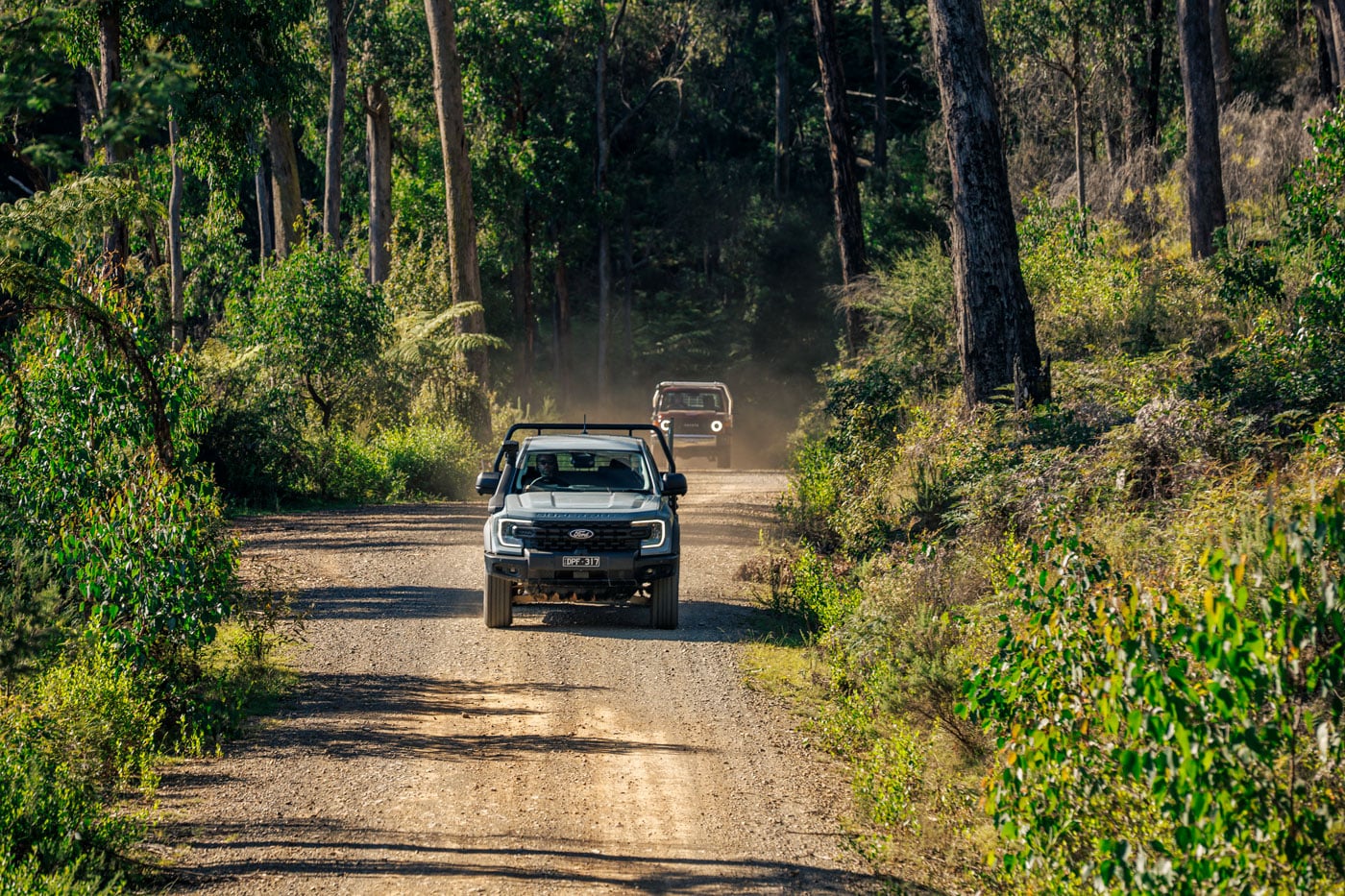
To see how the new Ranger variant performs against the old workhorse, we paired them against each other in our latest Club 4X4 head-to-head comparison.
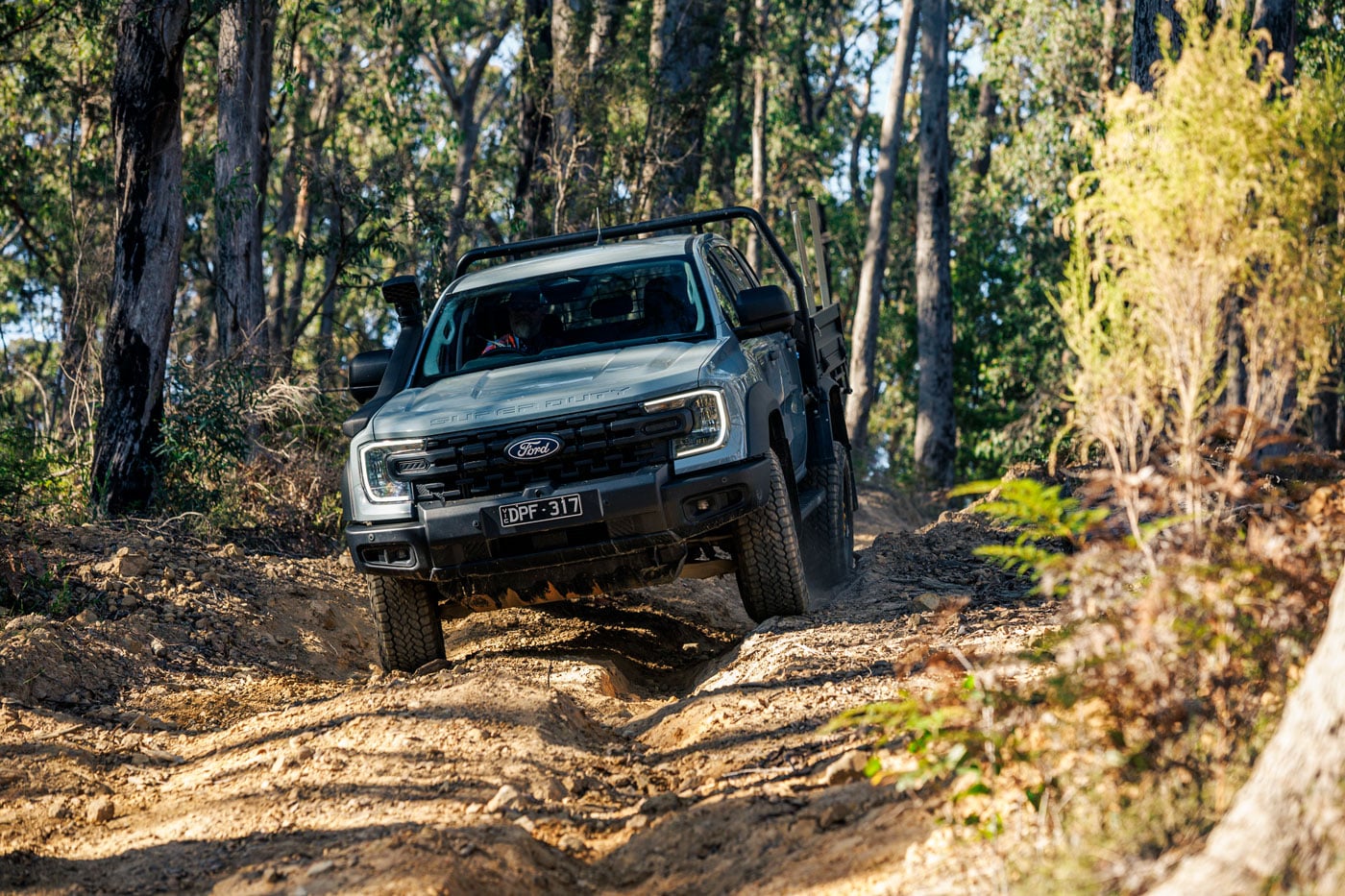
Ford Ranger Super Duty
The Ford Ranger Super Duty’s party trick is its carrying capacity. It offers a 4500kg GVM, 4500kg towing capacity and 8000kg GCM, all from a midsize 4×4 ute that happens to be based on the best-selling new vehicle in Australia.
That towing capacity is normally the realm of big US pick-up trucks, while the Super Duty’s payload smashes anything the 1500-class US trucks can offer. It also rides on the same relatively compact footprint as the midsize Ranger.
To achieve those numbers, the Ford Australia engineering team slid a heavy-duty chassis under the Ranger body and equipped it with heavy-duty axles and suspension components, some borrowed from other vehicles in Ford’s global showroom. The front diff comes from a Bronco Raptor, the rear diff from a Transit Jumbo van with beefed-up axles and internals, and the eight-lug hubs come from F-250 trucks.
There’s also a host of other beefed-up and bespoke parts included in the Ranger Super Duty. Ford Australia tells us that less than six per cent of the Super Duty’s chassis and underbody components are carried over from the regular Ranger.
Nestled within the chassis is a 130-litre diesel tank, so there’s no need to resort to aftermarket solutions. There are metal plates underneath it for protection, as well as similar plates protecting the drivetrain. This heavy-duty drivetrain and chassis gives the Super Duty the hardware to fulfill the needs of most touring four-wheel drivers and fleet operators.
The drivetrain remains the 3.0-litre diesel V6 engine backed by a 10-speed automatic transmission and dual-range transfer case. The transfer case is slightly different to that in other Ranger models, in that it doesn’t have a two-wheel drive setting. Instead, the 4×4 Auto setting is better suited to on-road use with the heavy loads the Super Duty is capable of hauling.
The engine has a different tune in the Super Duty compared with other V6 Rangers, to meet EU6 emissions standards for the category of vehicle it falls into. As a result, peak power drops from 165kW to 154kW, while peak torque remains at 600Nm. The revised tune also alters the torque curve to fatten up the midrange and make it better suited to work and haul use. The EU6 emissions regulations mean the Super Duty runs AdBlue SCR.
The 10-speed automatic transmission is also beefed up to handle the loads, while both the front and rear differentials get driver-selectable lockers. Again, the Super Duty ticks all the boxes.
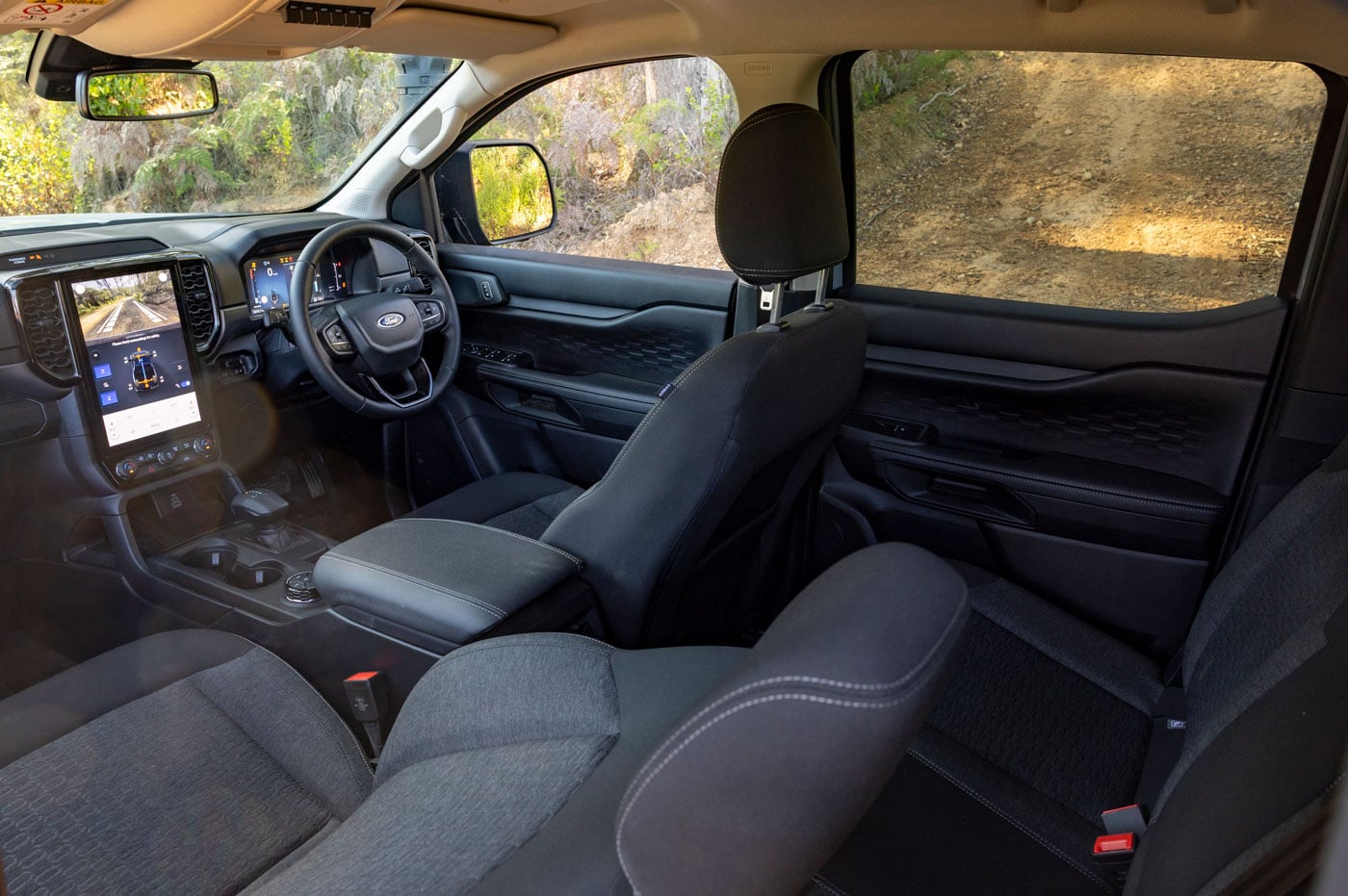
Ford Ranger Super Duty interior
Where the Ranger Super Duty differs massively from the LandCruiser 79 is inside, as it’s based on a modern vehicle and not a 40-year-old commercial truck that has been updated and improved over the years.
Anyone who has been inside a current-generation Ford Ranger would be familiar with the Super Duty’s cabin. It’s big, spacious and well equipped with the modern safety, comfort and convenience features you expect in a vehicle in 2026, including a 12-inch multimedia screen, dual-zone climate control and cushy seats.
This drive was in a standard Ranger Super Duty, while since then the XLT variant has become available, adding to the creature comforts with leather-trimmed seats, plus heating and cooling for the front two. The cabin in the Super Duty feels a world away from that of the LandCruiser 70 Series, and when you drive the two vehicles back to back, you can see and feel why buyers wanted more from a heavy-duty ute.
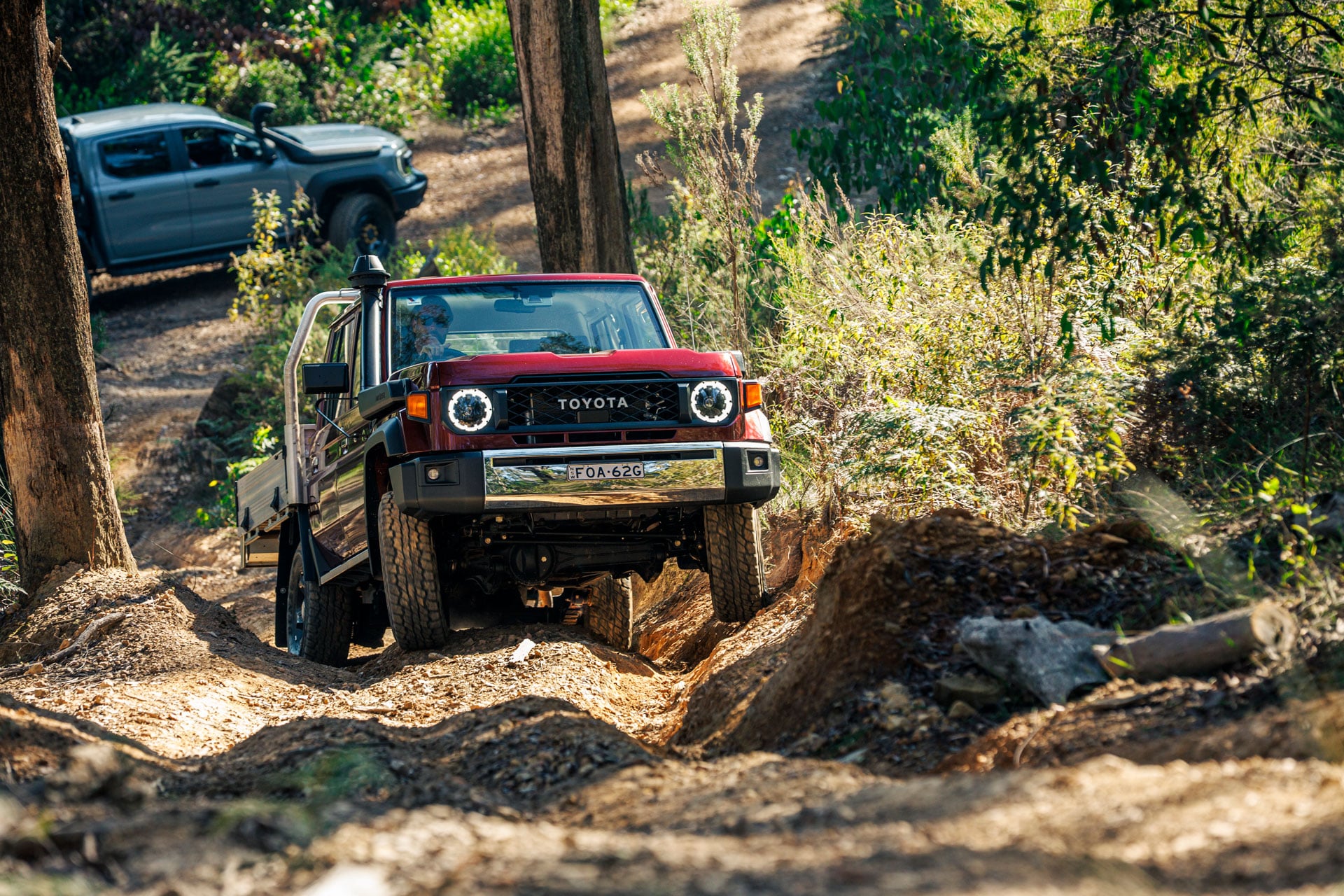
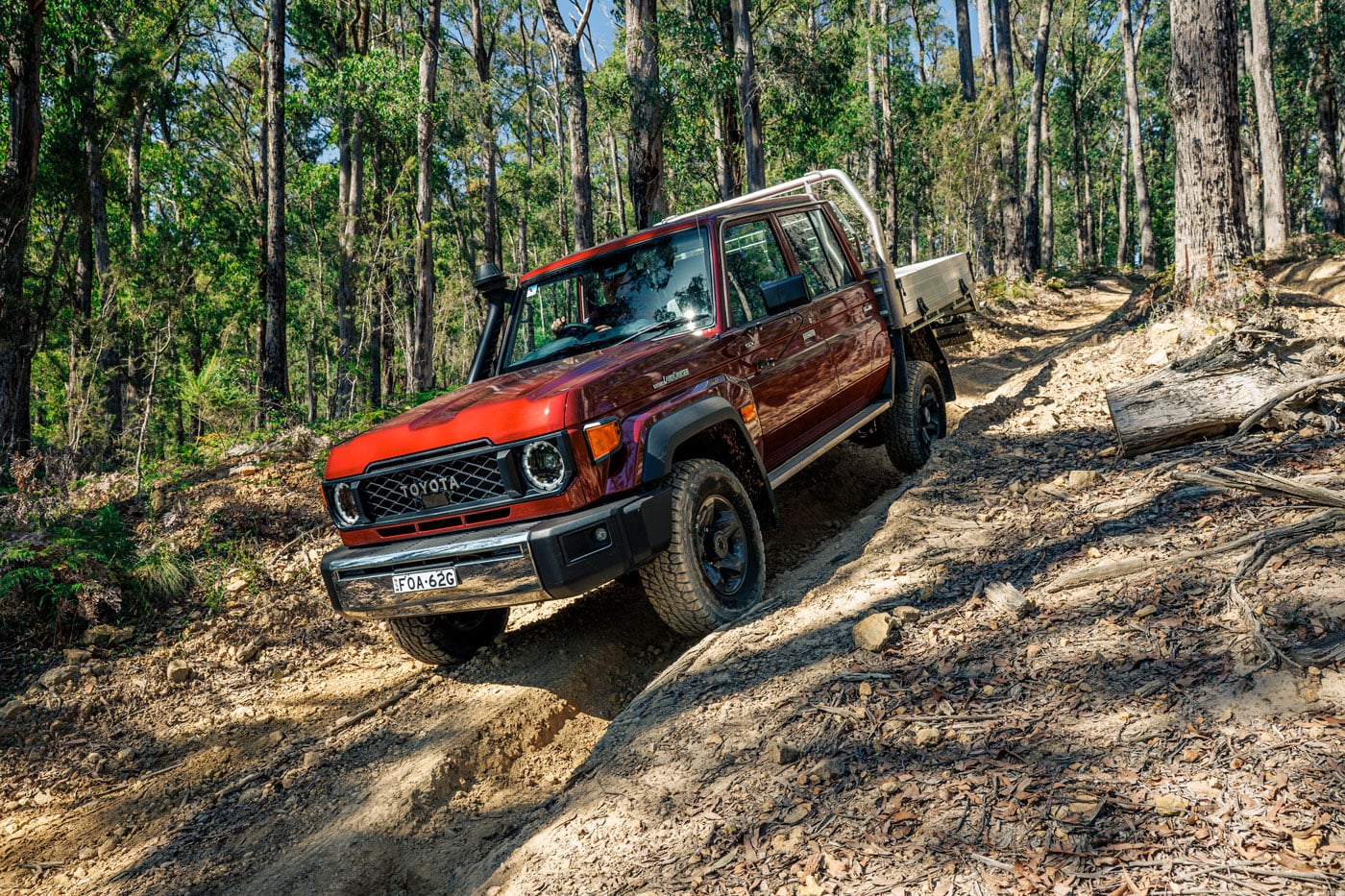
Toyota LandCruiser 79 GXL
The LandCruiser 70 Series has been the perennial favourite for farmers, four-wheel drivers, NGOs, militaries and industry fleets for four decades.
It has earned a reputation for rugged reliability, enduring capability and dependability that is unrivalled in Australia and around the world. Land Rovers and Nissan Patrols have come and gone over the years, and in recent times we’ve seen the Ineos Quartermaster arrive on the scene, but the LC70 remains the benchmark for this style of vehicle.
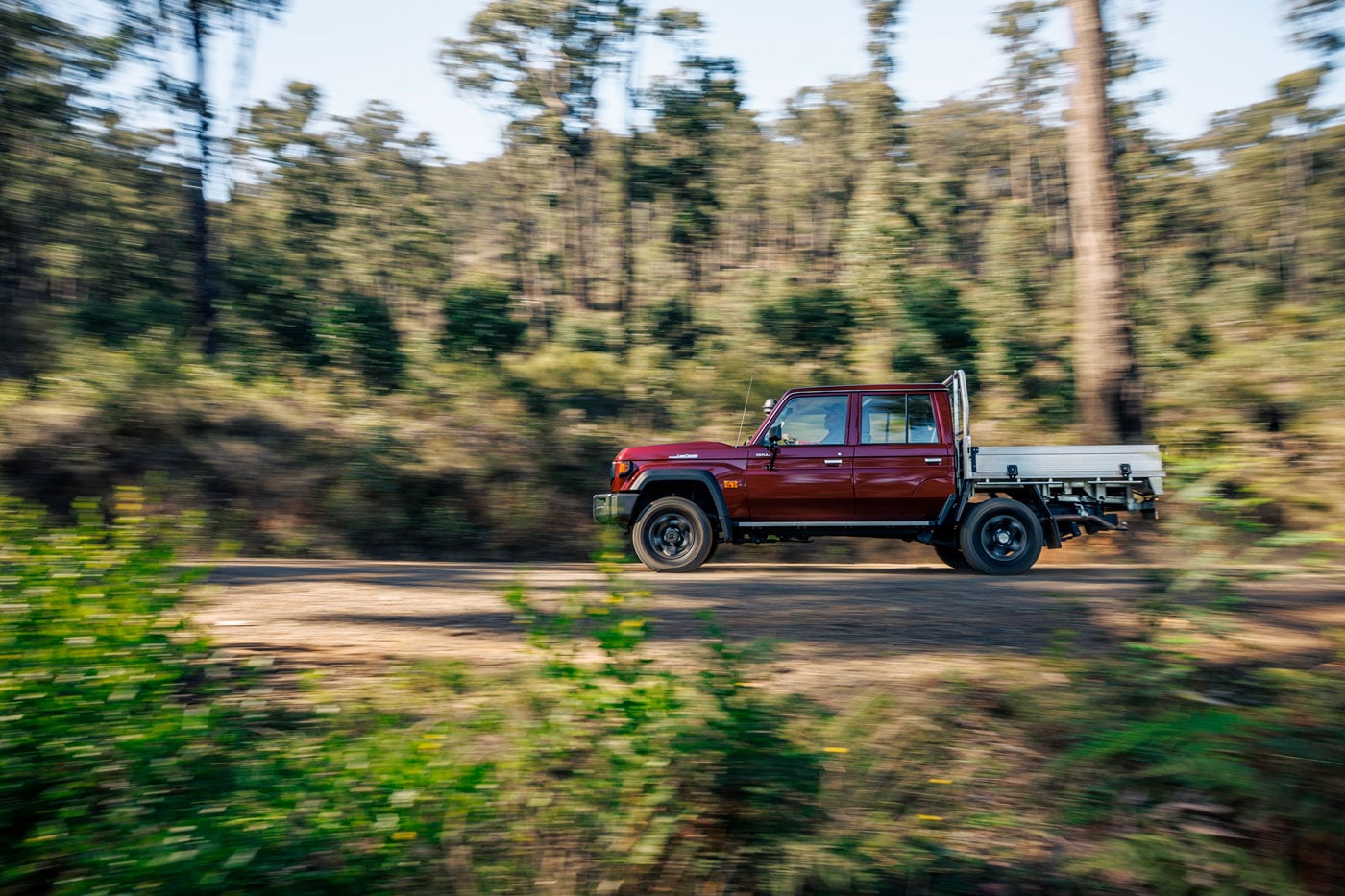
The most recent versions of the LC70 were launched in 2024 and are available in LC76 wagon, LC78 Troopcarrier and LC79 cab-chassis variants, in three grades. Here we have the LC79 double-cab with a factory aluminium tray in top-of-the-range GXL trim to compete with the Ranger Super Duty. Don’t let the top-of-the-range moniker deceive you, the LandCruiser is still a very spartan, fit-for-purpose work vehicle.
All LC70s are now powered by Toyota’s 1GD-FTV 2.8-litre inline four-cylinder diesel engine, backed by a choice of five-speed manual gearbox or six-speed automatic transmission. Our GXL Cruiser came fitted with the latter, ahead of a dual-range transfer case. Being a GXL grade, it also gets front and rear locking differentials to give it similar hardware to the Super Duty.
LandCruisers retain live axles at the front and rear which, again, is a more rugged design compared to the Ford’s IFS. However, the Cruiser doesn’t have a lot of wheel travel, so there’s no real advantage in the live-axle design here. Both vehicles have locking front differentials, so again there’s no advantage to the live axle.
While the four-cylinder engine might not have the appeal of its 4.5-litre V8 predecessor, it makes more power and torque than the V8, although its 150kW and 500Nm can’t match the outputs of the Ford V6. That said, it works superbly with the automatic transmission and gives the 79 the power to get the job done, even if it doesn’t have the V8 rumble that drew all the concrete cowboys to the previous model.
You could say the Cruiser has gone back to its working-truck brief and is more at home on the farm or in the bush than the previous V8 diesel model. The automatic transmission also makes it more appealing to fleet owners, where not everyone can drive a manual gearbox.
Toyota LandCruiser 79 GXL interior
The double-cab 79 Series is one of the later body styles in the 40-plus years of the model, but it still bears a strong resemblance to the original models that came before it.
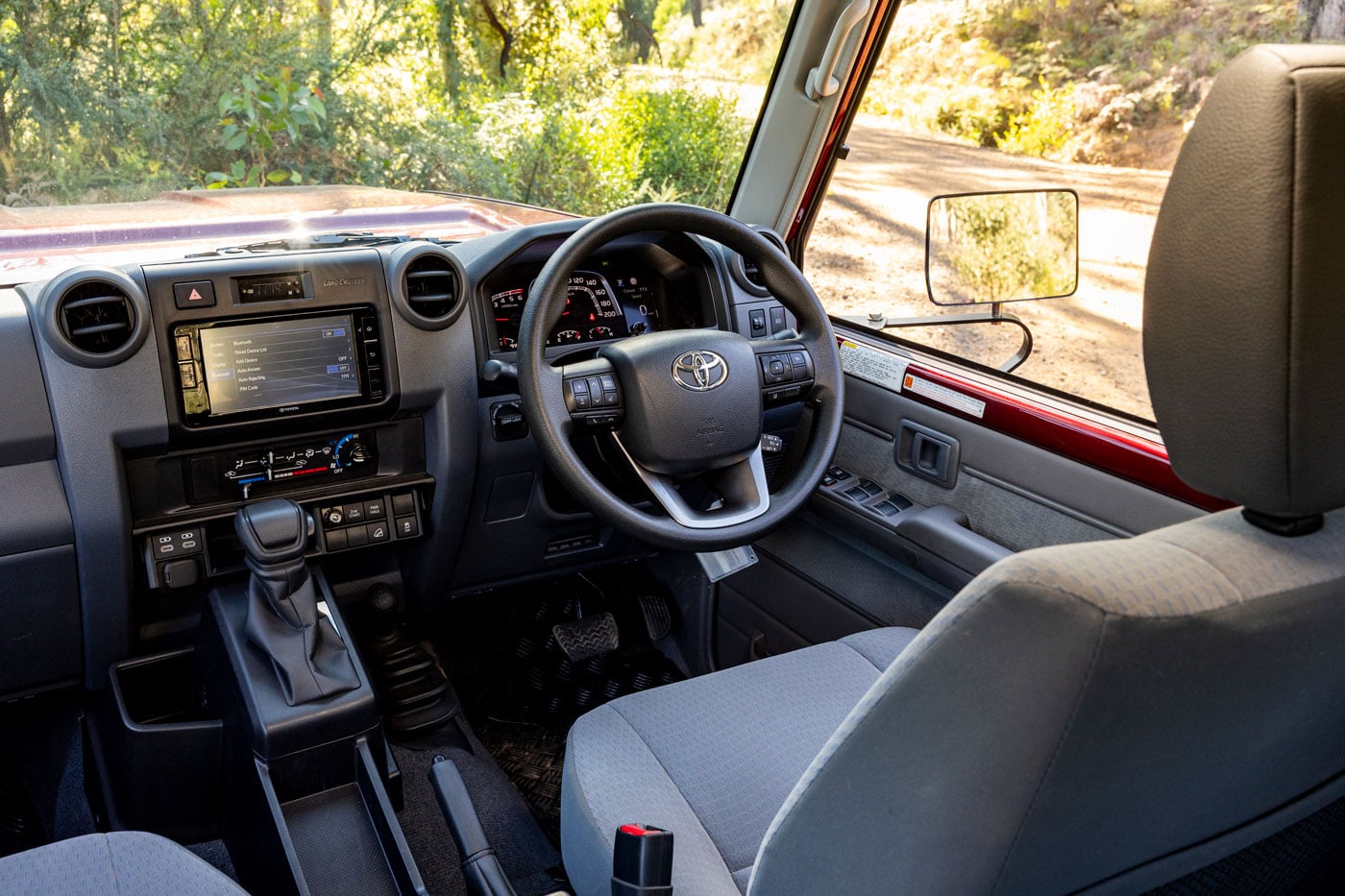
The cabin is narrow and upright, with few creature comforts. The air conditioning still uses the same sliding controls it did in 1985 and that’s not a bad thing, as they work well. The media system, if you can call it that, has a 6.7-inch screen which by today’s standards is tiny, and the image quality is poor. You can get Apple CarPlay, but it’s via cable connection only. Other features are available via Bluetooth.
Being a GXL grade, this 79 does get power windows, front and rear diff locks and alloy wheels. Flash! LC70s have had ABS for a while now, and the 2024 updates gave it a lane-departure warning chime, but that’s about the extent of the safety features.
On- and off-road comparison
Despite the latest updates, the 79 still feels and drives like a vintage commercial vehicle, and that’s a huge part of its charm.
It feels solid and honest, as there’s little, if any, padding masking its heavy-duty construction. There’s no fat on the 79 and it actually feels nimble on bush tracks, where its narrow body and clear lines of sight make it the better vehicle to drive in tight going.
The driver sits lower in the Ranger, where the windscreen sweeps back over the cabin and the door sills are higher, insulating the driver from their surroundings. As a result, you need to be more careful with vehicle placement, taking note of what’s ahead of you and using the 360-degree cameras to know where the vehicle is on the track.
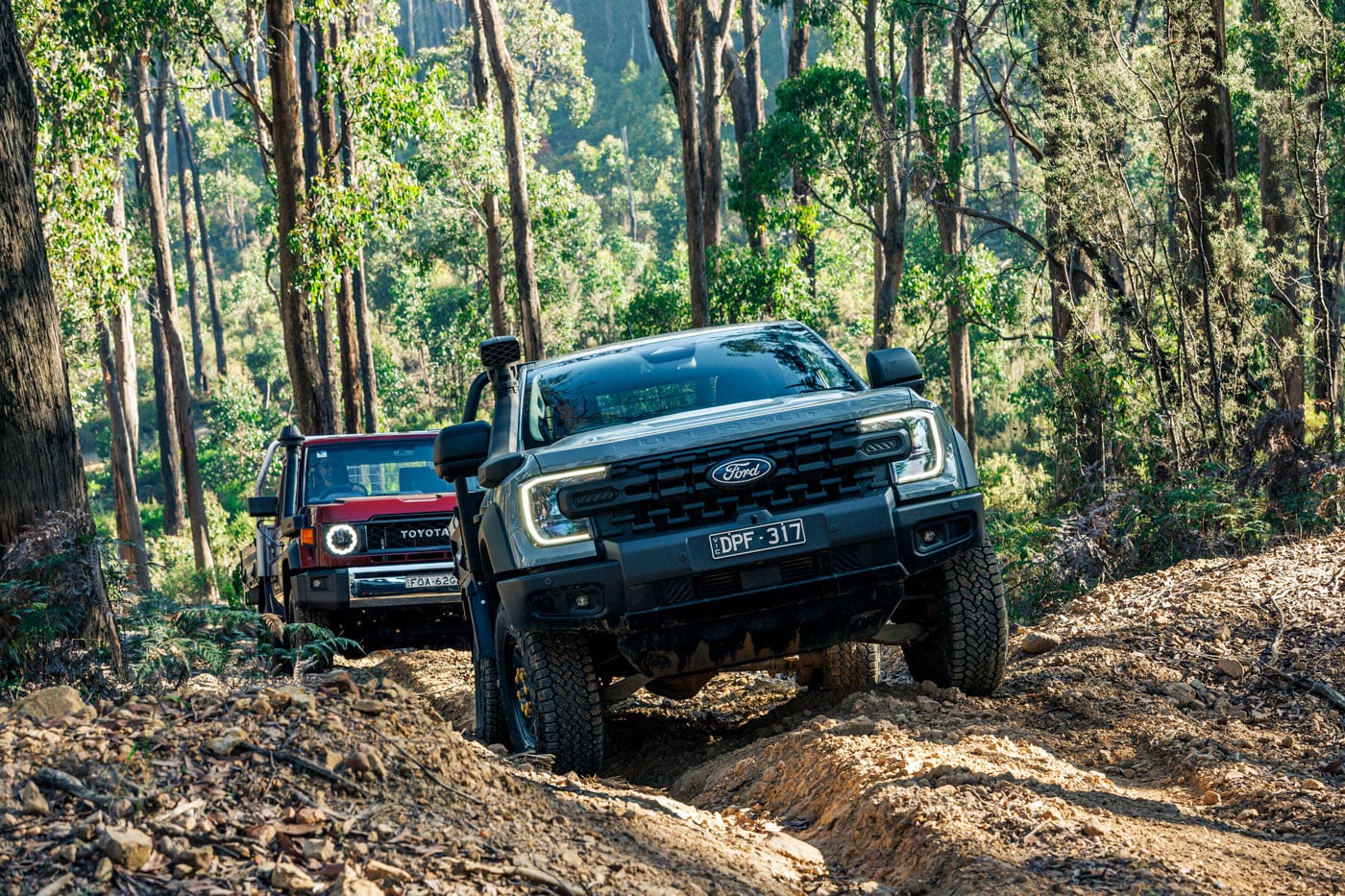
The Super Duty feels stiffer than a regular Ranger in the way it drives on- and off-road, and you feel the mass of the LT-construction tyres and steel wheels on rough roads.
There’s no comparison between the way these two vehicles handle, as the Ford is the clear winner here. It is, in fact, surprising just how dynamic it is on a winding road, as it steers better than any heavy-duty truck on those tyres has any right to.
This alone will be a deciding factor for many buyers considering these two utes, along with the massive difference in the Ford’s interior and equipment levels.
| Off-road specification | Ford Ranger Super Duty | Toyota LandCruiser 79 GXL |
|---|---|---|
| Approach angle | 36.1 | 33 |
| Rampover angle | 26.3 | 22 |
| Departure angle | 28.6 | 27 |
| Ground clearance | 295mm | 302mm |
| Wading depth | 850mm | 850mm |
Final verdict
The LandCruiser 79 might have all the history, character and charm that the Ford Ranger sorely lacks, but when it comes to getting the job done, it is left for dead by the Super Duty.
The Ford has higher load and towing capacities, more power and torque, is a world away in comfort and safety, and its road manners make it a vehicle that is easier to drive for anyone not accustomed to the habits of older trucks.
It’s true that the modern Ranger does fall foul of over-complexity in some of its operating systems, but this is true for all modern vehicles and it’s getting worse. This is where the LandCruiser makes you appreciate basic functionality and the simple operation of everything you need, and nothing you really don’t.
At the end of the day, the Ranger Super Duty is the better all-in-one vehicle package here.
Pros and cons
Ranger Super Duty pros
- 4500kg GVM and 4500kg towing capacity
- More power and torque than the 79
- Modern, comfortable and well-equipped interior
Ranger Super Duty cons
- More complex operating systems
- Feels stiffer than a regular Ranger off-road
- Larger footprint makes vehicle placement more difficult
LC79 pros
- Proven rugged reliability and dependability
- Narrow body and clear sight lines suit tight bush tracks
- Simple, functional controls and systems
LC79 cons
- Lower payload and towing capacity than the Ranger
- Spartan interior with limited safety and comfort features
- Feels and drives like a commercial vehicle
Specs
| Specification | Ford Ranger Super Duty | Toyota LandCruiser 79 GXL |
|---|---|---|
| Engine | V6 turbo-diesel | Inline four-cylinder diesel |
| Capacity | 2993cc | 2755cc |
| Max power | 154kW @ 3250rpm | 150kW @ 3000-3400rpm |
| Max torque | 600Nm @ 1750rpm | 500Nm @ 1600-2800rpm |
| Transmission | 10-speed automatic | 6-speed automatic |
| 4×4 system | Auto on-demand 4×4 with high and low range | Part-time dual-range 4×4 |
| Construction | 4-door cab-chassis | 4-door cab-chassis |
| Front suspension | IFS with wishbones and coil springs | Live axle with coil springs |
| Rear suspension | Live axle with leaf springs | Live axle with leaf springs |
| Tyres | LT275/70R18 on steel wheels | LT265/70R16 on alloy wheels |
| Kerb weight | 2675kg ex tray | 2185kg |
| GVM | 4500kg | 3510kg |
| Payload | 1825kg excluding tray | 1270kg |
| Towing capacity | 4500kg | 3500kg |
| GCM | 8000kg | 7010kg |
| Seating | 5 | 5 |
| Fuel tank | 130L | 130L |
| ADR fuel consumption | N/A | 9.6L/100km |
Want $750 worth of fuel for your next 4×4 adventure, or an EcoFlow DELTA 3 portable power station? Take part in the new 4X4 Australia touring survey and you could win one of the prizes on offer.
We want to find out how Australian 4×4 enthusiasts actually travel, camp and use their vehicles. The survey covers everything from your camping setup and how often you get away, to the gear you already own and what you’re planning to buy next.
Whether you sleep in a swag, tent, rooftop tent, camper trailer, caravan or your vehicle, we want to hear from you. We’re also asking about your 4×4, touring gear, insurance, travel habits and the activities you get up to when you head away.

We’re particularly interested in what your next touring adventure looks like. Are you planning a big lap of Australia, heading bush for a few weeks, or sticking to shorter weekend trips? The survey gives us a chance to understand where our readers are travelling, how they’re setting up their vehicles and what challenges they encounter along the way.
The results will help us build a clearer picture of Australia’s touring community and what matters to 4×4 owners when planning their next trip. They’ll also help shape the stories, buying guides and other coverage we produce for 4X4 Australia, including the gear and vehicles we put through their paces.
There are three $750 BP fuel vouchers and an EcoFlow DELTA 3 portable power station up for grabs. The DELTA 3 is the same unit we recently tested in our portable power station test, where it took out our Best Mid-Capacity (1000-1500Wh) category. The prize unit is a used example from that test, although it has only been tested under controlled lab conditions rather than on tour across Australia.
The survey should only take a few minutes to complete, so have your say and you could score something useful for your next adventure. If you’re a regular tourer, occasional camper or simply planning your first proper 4×4 trip, we’d like to hear from you. Your answers will help us understand what Australian 4×4 enthusiasts are doing out there and what you want to see from 4X4 Australia.
T&Cs apply. Entries close October 25, 2026.
Australians have taken to American pick-ups in a big way, but we’ve generally had to accept a compromise somewhere along the line.
A 1500 gives you the space, comfort and petrol driveline that makes these things surprisingly liveable day-to-day. However, start adding a family, a canopy full of camping gear and a few hundred kilos of tow-ball weight and payload can disappear remarkably quickly. You can fix that with aftermarket GVM upgrades, but once you’re changing suspension and chasing engineering approvals, the simplicity of buying a big truck to do big-truck things starts getting a bit lost.
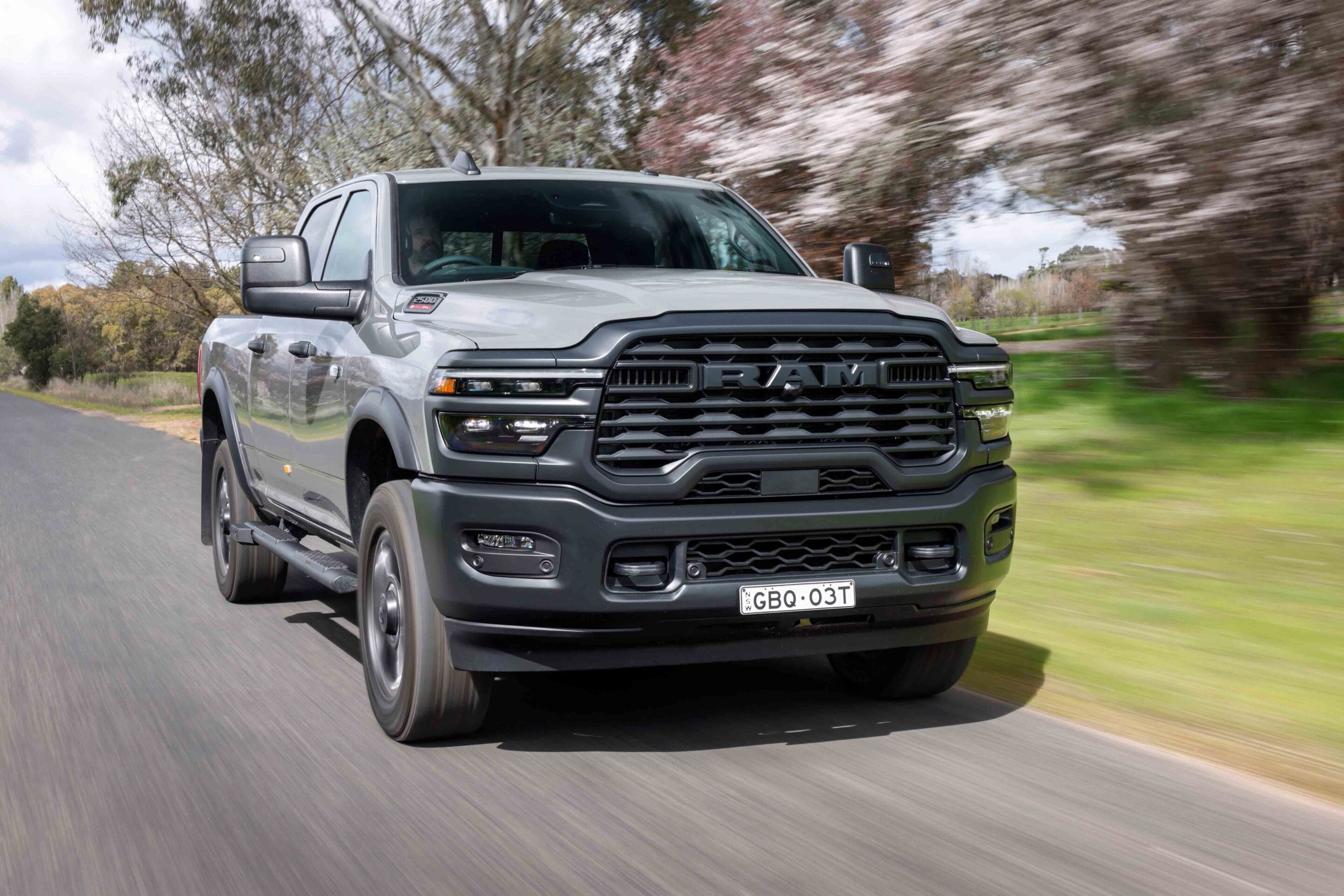
Step up to a 2500 and you get the heavy-duty chassis, axles and running gear, but the big diesel hanging over the front axle brings plenty of its own weight. Going further again into higher GVM territory can mean stepping into light-truck registration and all the baggage that comes with it. The new Ram 2500 Warlock takes a much simpler approach.
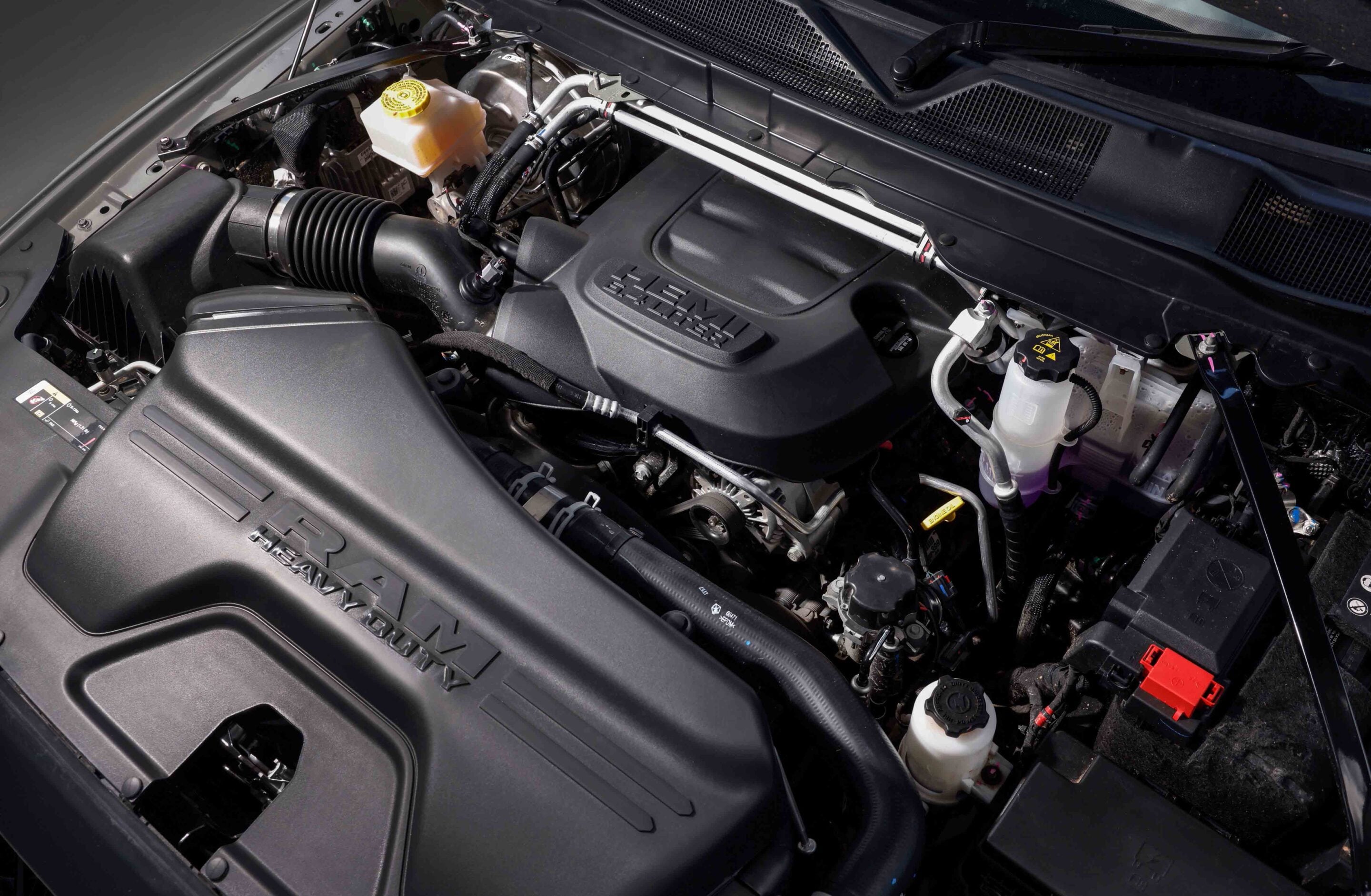
It keeps the proper 2500 underneath, swaps the Cummins diesel for a 6.4-litre petrol HEMI V8 and, in the process, drops 490kg from the truck. At the same 4495kg GVM, that gives the Warlock a whopping 1275kg of factory payload. And that could make this the American truck that suits more Australians than any of them.
Pricing and specifications
The 2026 Ram 2500 Warlock is priced from $157,950 plus on-road costs, with Australian deliveries beginning in October 2026. It pairs a naturally aspirated 6.4-litre HEMI V8 producing 306kW and 582Nm with an eight-speed automatic, part-time four-wheel drive and low range.
At 3220kg kerb weight, the Warlock has a 4495kg GVM, 1275kg payload, 10,001kg GCM and 4500kg maximum conventional braked towing capacity. Standard Warlock hardware includes Bilstein off-road dampers and LT285/60R20E Goodyear Wrangler Duratrac RT tyres.
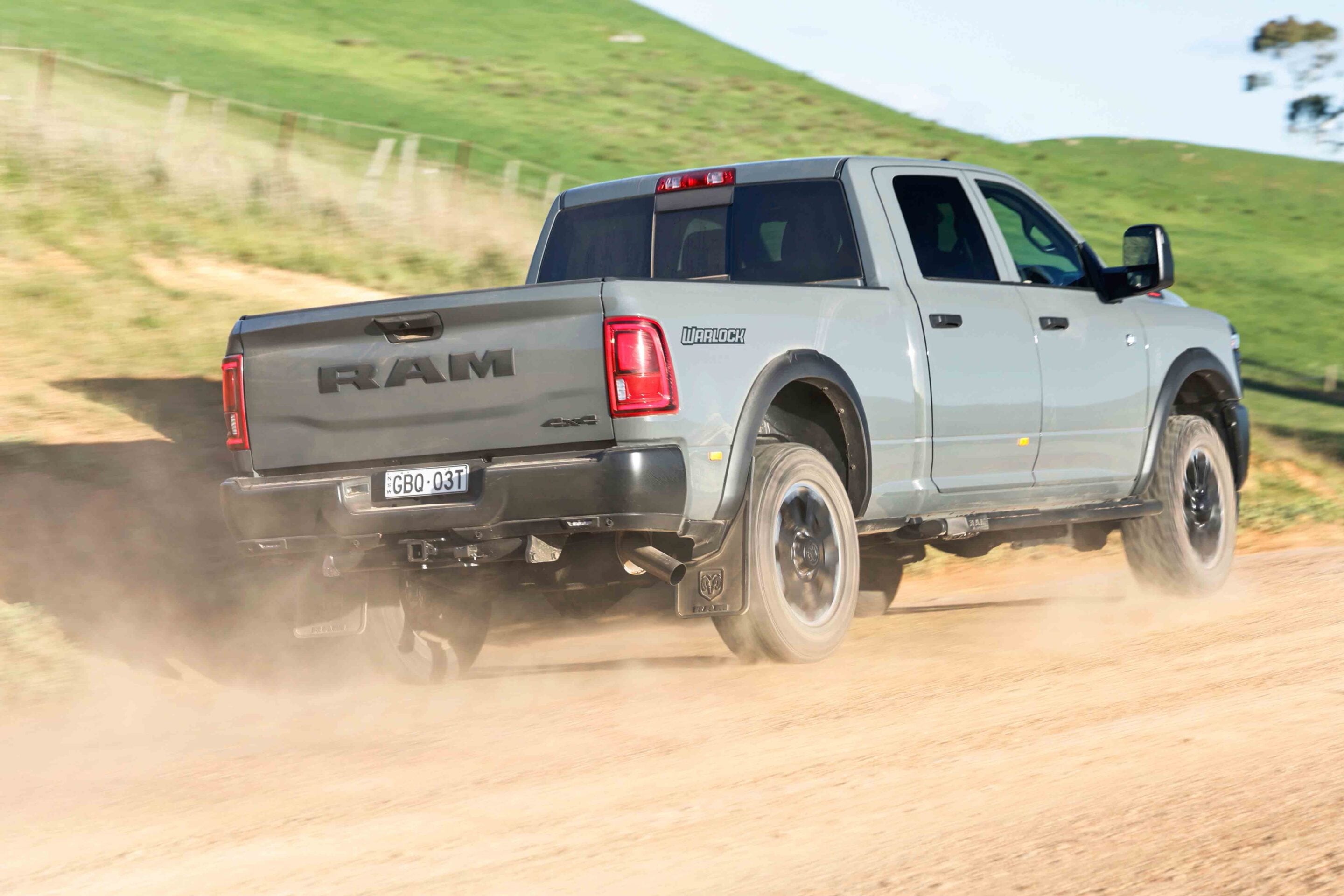
So, what exactly is a Ram 2500 Warlock?
The Warlock starts with the bones of a proper Ram 2500 Heavy Duty, but takes it in a distinctly different direction to the familiar Cummins-powered Laramie.
Behind the HEMI is ZF’s excellent 8HP75 eight-speed automatic, rated to 750Nm and arguably one of the best automatic transmissions in the business. It’s also considerably lighter than the heavy-duty TorqueFlite HD eight-speed required behind the Cummins, while shorter 3.73:1 diff gearing suits the petrol engine’s revvier nature. Importantly, Ram hasn’t made it a soft-roader.
There are solid axles and five-link coil suspension at both ends, a proper part-time transfer case with 2.64:1 low range and a 2721kg rear axle rating – identical to the Cummins 2500. Underneath all the black trim, this remains a proper heavy-duty truck.
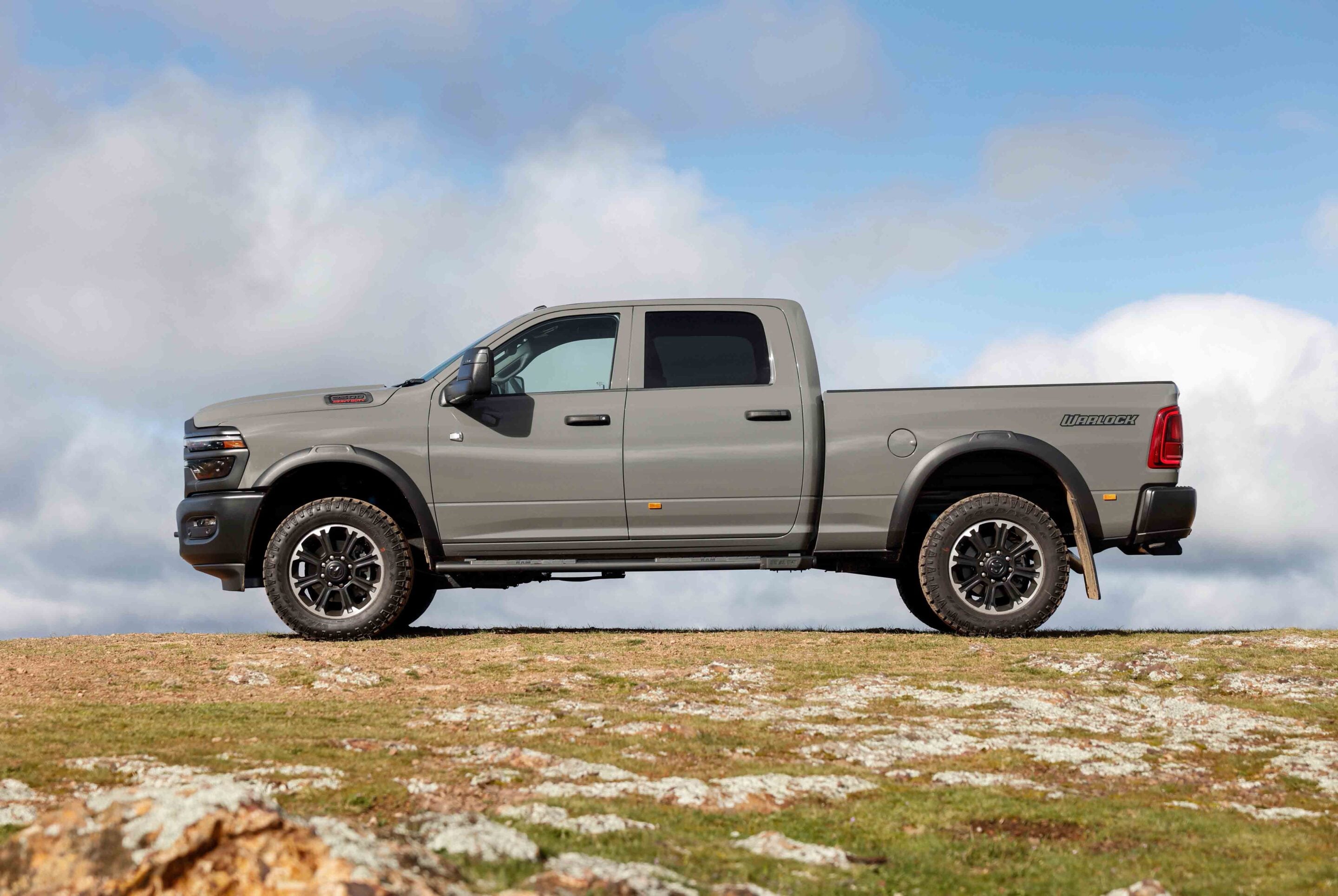
Ram 2500 Warlock vs Ram 2500 Cummins
The biggest difference between the Warlock and diesel Ram 2500 isn’t power, it’s weight and torque.
The 6.4-litre HEMI Warlock is only 7kW down on the Cummins, but gives away a whopping 876Nm. In return, removing the heavy diesel drivetrain drops 490kg from the kerb weight, turning that directly into an extra 490kg of payload while retaining the same 4495kg GVM.
| Specification | 2500 Warlock HEMI | 2500 Laramie Cummins HO |
|---|---|---|
| Engine | 6.4L petrol V8 | 6.7L turbo-diesel I6 |
| Power | 306kW | 313kW |
| Torque | 582Nm | 1458Nm |
| Kerb weight | 3220kg | 3710kg |
| GVM | 4495kg | 4495kg |
| Payload | 1275kg | 785kg |
| GCM | 10,001kg | 12,750kg |
| Conventional towing | 4500kg | 4500kg |
| Rear axle rating | 2721kg | 2721kg |
Black. And then some more black
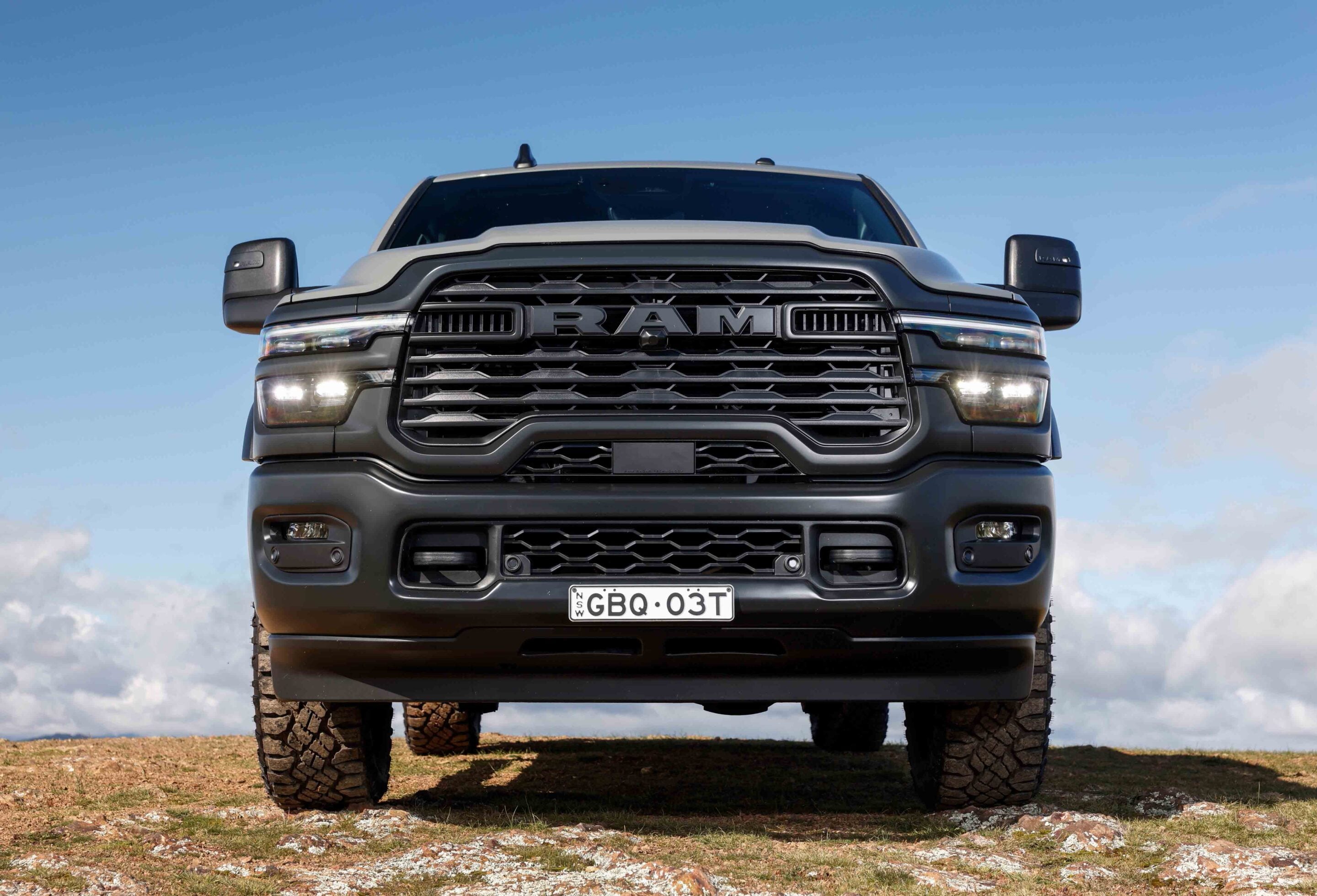
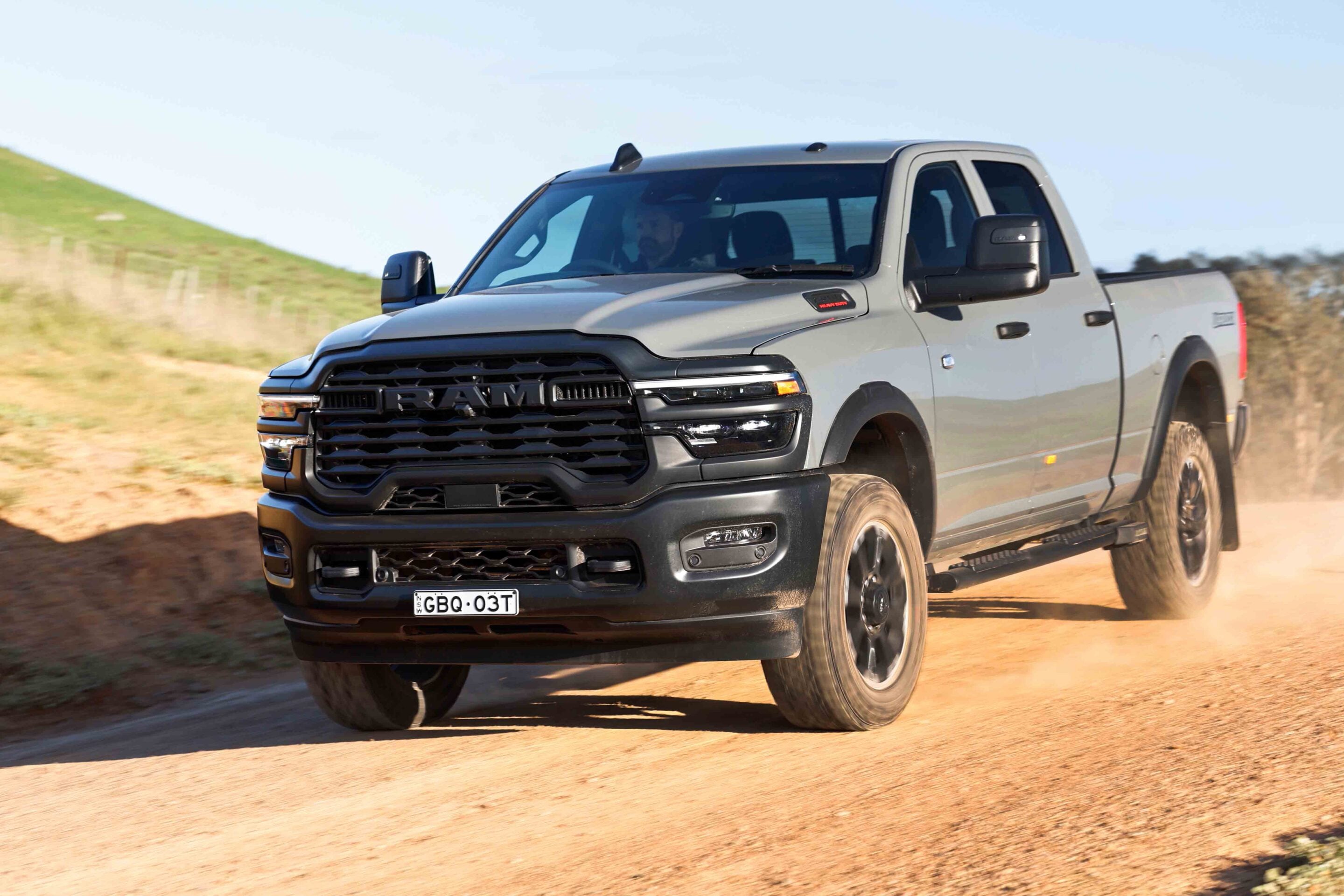
If you like black, Ram has some good news for you. The Warlock appears to have been designed by walking around a 2500 and asking whether every visible component could be made black.
The grille, bumpers, headlight surrounds, badges, mirrors, side steps and wheelarch flares all get the treatment, with Warlock decals and 20-inch alloys completing the look. Even inside the headlights is black. Personally, I reckon they’ve gone about two tins of paint too far.
Then again, I’ve never thought the Ram was the best-looking of the American heavy-duty pickups, yet it’s comfortably the most popular in Australia, so perhaps don’t take styling advice from me. Either way, there’s no mistaking the Warlock for the chrome-heavy Laramie. It looks tougher, simpler and considerably less interested in subtlety.
Big truck, big cabin
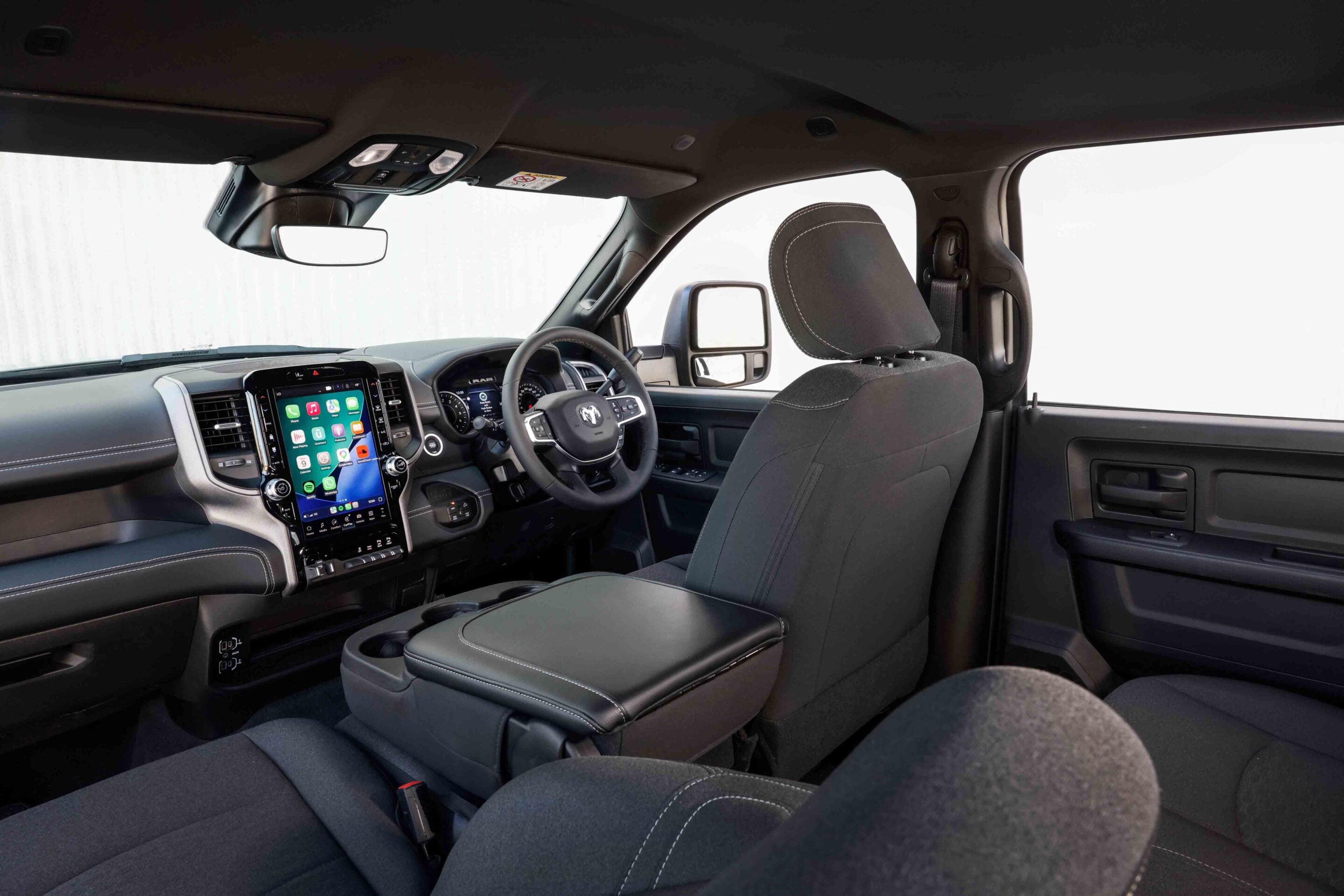
One of the enduring attractions of a full-size American pickup is simply how much room you get, and the Warlock doesn’t disappoint. Four adults could cross the country in this thing with space to spare.
Technically, it’ll take six. There’s a third seat hidden beneath the folding front centre armrest, while the rear bench accommodates three more. The two centre passengers draw the short straws, but having six seats available at all is a neat bit of practicality.
There’s useful storage beneath the rear seat, although I’m disappointed Ram hasn’t given the 2500 a flat rear floor. The transmission hump means the middle passenger sits with their feet either side of it, while bulky camping gear can’t simply be slid across the cabin floor.
Up front, physical controls remain for temperature, fan speed, volume and important functions such as Tow/Haul. In an increasingly screen-obsessed world, that feels like progress rather than regression.
What is the Warlock like to drive?
On paper, the Ram 2500 Warlock’s 582Nm looks almost comical beside the Ram 2500 Cummins’ 1458Nm. On the road, you stop worrying about it pretty quickly.
The 6.4-litre HEMI V8 is rev-happy, responsive and piles on speed surprisingly well for something weighing 3.2 tonnes. A lot of the credit goes to the ZF 8HP75 eight-speed automatic, which is beautifully calibrated to the petrol engine. It’s happy to grab another gear or two and let the HEMI rev rather than pretending there’s diesel-like torque hiding down low.
And the noise is fantastic. There’s no point dancing around it: A naturally aspirated American V8 remains a very enjoyable thing. You can also feel the 490kg weight saving compared with the Cummins-powered Ram 2500. The Warlock feels lighter on its feet and more responsive, although unladen it almost feels like it wants a few hundred kilos in the tray to settle the ride.
Steering is suitably easy for a heavy-duty pickup this size. The brakes require a little more commitment: initial pedal assistance feels underdone, but push through that firm pedal and there’s plenty of stopping power. The big towing question remains, but as an everyday Ram 2500 petrol V8 powertrain, the HEMI absolutely works.
Taking it off-road
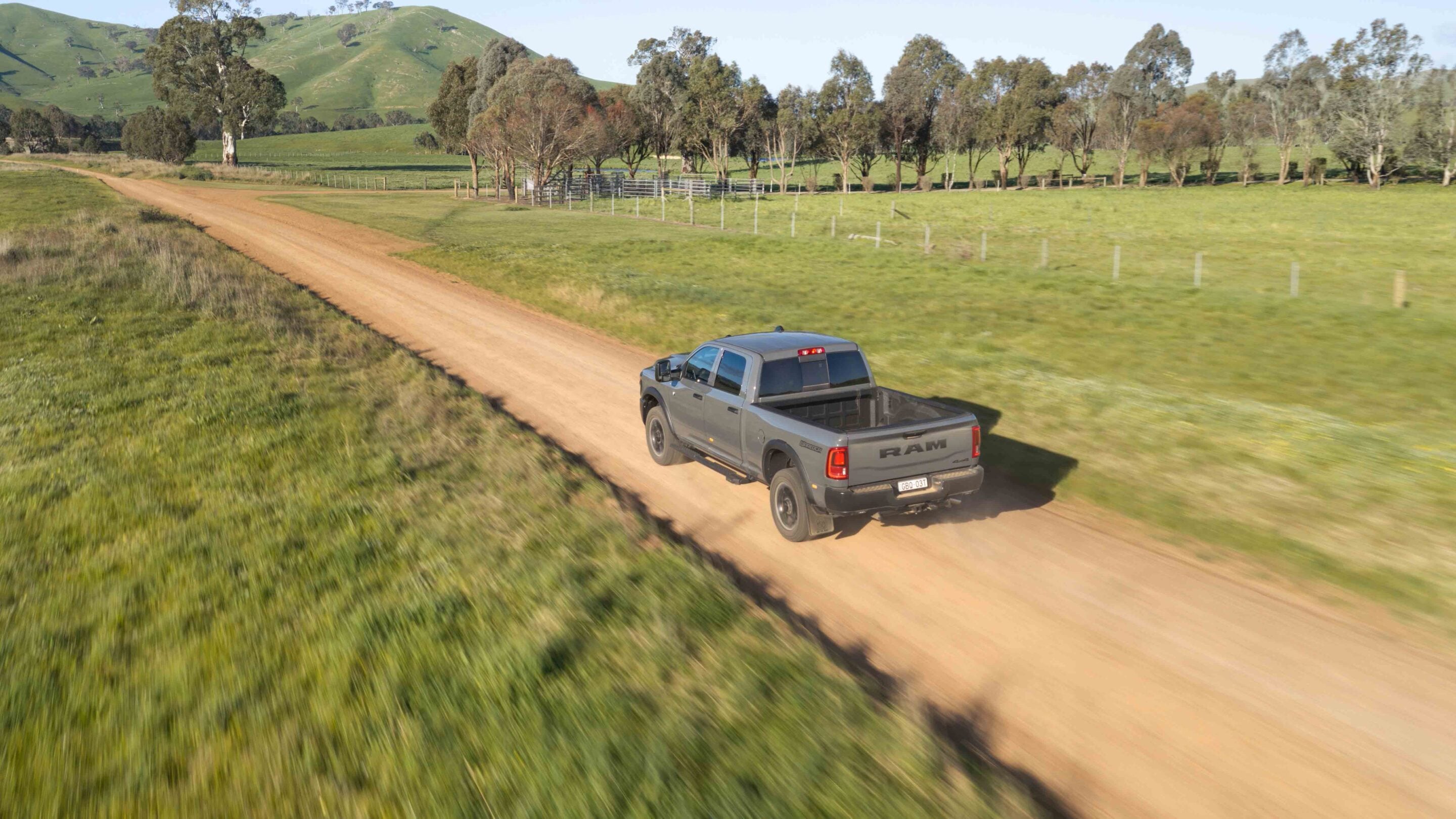
There’s something refreshingly old-school about taking the Ram 2500 Warlock off-road.
There are no rock, mud, sand or mountain modes to scroll through. Select low range, point it where you want to go and drive the thing. And it works remarkably well. Solid axles and five-link coil suspension at both ends give the Warlock impressive articulation for a 3.2-tonne heavy-duty pickup. There isn’t enormous droop compared with more dedicated solid-axle 4x4s, but that’s missing the point.
| Off-road specification | Ram 2500 Warlock HEMI V8 |
|---|---|
| Approach angle | 22.9 |
| Departure angle | 25.8 |
| Ramp-over angle | 22.0 |
This is still a heavy-duty tow vehicle that can comfortably tackle proper off-road work, not something pretending to be a rock crawler. The 6.4-litre HEMI V8’s torque arrives higher in the rev range than a big diesel’s, but low range largely makes that irrelevant. With eight gears, a useful 2.64:1 low-range reduction and shorter 3.73:1 diff gearing, there’s plenty of gearing available to keep the V8 where it needs to be.
More importantly, losing 490kg compared with the Cummins-powered Ram 2500 makes a difference here, too. There’s less mass hanging over the front axle, and the Warlock feels better balanced and more willing to work with the terrain. Sometimes simple really is better.
Why its 1275kg payload changes everything
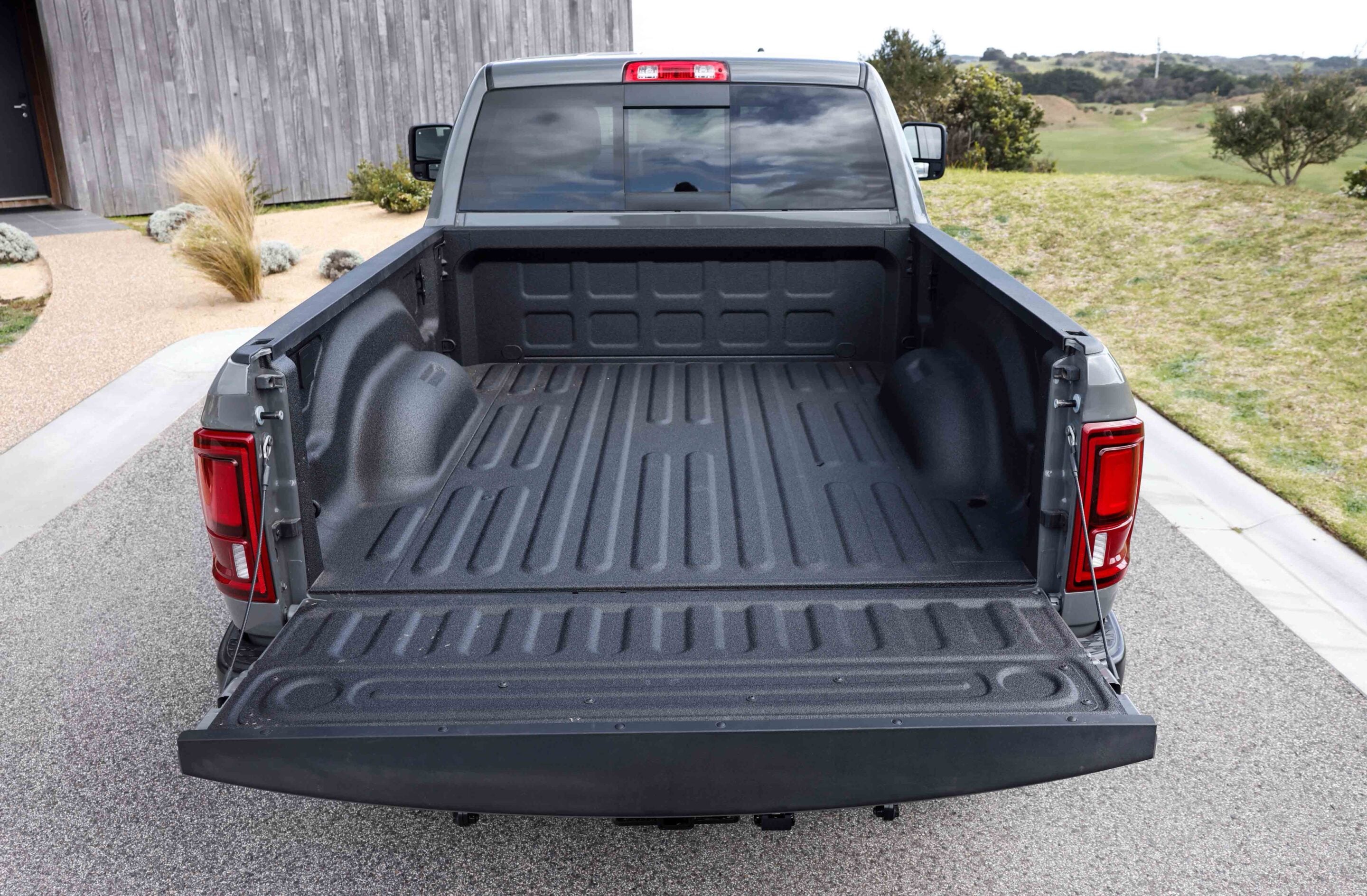
The Warlock’s headline number isn’t 306kW, 582Nm or even that 6.4-litre capacity. It’s 1275kg of payload.
Look at the touring 4×4 builds running around Australia and you’ll understand why. A fully equipped canopy can easily put 500 to 600kg onto a vehicle. Add a bullbar, winch, roof rack, bigger wheels and tyres, suspension and a few other accessories and you can have 800kg tied up in the build before loading your family, water, food, recovery equipment or camping gear. And that’s before putting a caravan on the towball.
Rather than immediately looking for an aftermarket GVM upgrade, the Warlock’s 4495kg GVM and 3220kg kerb weight leave 1275kg of factory payload to actually build the touring vehicle you bought it to become.
There’s proper hardware underneath that number, too. Its 2721kg rear axle rating is identical to the Cummins Ram 2500, while a 220A alternator provides a useful starting point for the substantial lithium battery banks and DC-DC charging systems increasingly fitted to touring builds. And crucially, having all that payload doesn’t mean giving away conventional towing capacity.
2500 Warlock vs 1500: The payload problem
This is where the case for the Ram 2500 Warlock starts getting particularly compelling.
Ram 1500s can tow up to 4500kg and, on paper, their payload figures aren’t terrible. The 1500 Express Black has 1014kg, while the Rebel has 881kg. But payload is only part of the story. Ram also imposes a combined limit on weight in the tub and on the towball: 520kg for the Express Black and just 500kg for the Rebel.
Take the Rebel as an example. Put a 450kg towball load on it and you’ve got just 50kg of its permitted combined tub-and-ball capacity remaining. That’s before the fridge, drawers, canopy, recovery gear or anything else you planned to carry in the back. And that’s the fundamental difference. A Ram 1500 is an excellent tow vehicle, but turning one into the sort of heavily accessorised touring rig Australians love can quickly become a numbers exercise.
The Warlock starts from the other end. Its 1275kg payload, 4495kg GVM and heavy-duty 2500 running gear mean you can add a serious touring fit-out and still have useful capacity for people, gear and towball mass. For anyone planning a 600 to 800kg touring build, that distinction is enormous.
| Specification | Ram 1500 Express Black | Ram 1500 Rebel | Ram 2500 Warlock |
|---|---|---|---|
| Kerb weight | 2491kg | 2624kg | 3220kg |
| GVM | 3505kg | 3505kg | 4495kg |
| Payload | 1014kg | 881kg | 1275kg |
| GCM | 7711kg | 7711kg | 10,001kg |
| Max braked towing | 4500kg | 4500kg | 4500kg |
| Tub + towball limit | 520kg | 500kg | – |
How much can the Ram 2500 Warlock really tow?
The Ram 2500 Warlock can tow up to 4500kg with a 70mm towball, or 3500kg using a conventional 50mm ball. With the genuine gooseneck setup and air brakes, that climbs to 6700kg.
This is where its 10,001kg GCM becomes particularly important. Take the Warlock’s full 4495kg GVM and add a 4500kg trailer and the simple headline arithmetic comes to 8995kg – still 1006kg beneath GCM. So unlike plenty of tow vehicles, GCM doesn’t immediately force you to choose between using the vehicle’s payload and using its advertised towing capacity.
There is an important qualification. Towball mass forms part of the vehicle’s loaded mass and is not carried by the trailer’s axle load, so you can’t simply add every maximum number together and call it done. The 2495kg front and 2721kg rear axle limits, trailer ATM, towball mass and individual tyre and coupling ratings still need to be respected. However, fundamentally, the Warlock’s numbers give you an unusually large amount of room to work with.
When the Cummins Ram 2500 still makes more sense
There is, of course, a point where the Cummins-powered Ram 2500 starts making a lot more sense.
Build the Warlock into a tourer, hook 3.5 or four tonnes behind it and spend 20,000km dragging that combination around Australia and you’re going to notice those missing 876Nm. The HEMI will do the job, but it’ll need revs and gears where the Cummins can simply lean on its enormous 1458Nm. You’ll notice it at the bowser, too.
A 117-litre fuel tank is reasonable until you combine a naturally aspirated 6.4-litre petrol V8 with several tonnes of caravan, headwinds and Australian highway speeds. For serious long-distance towing, I’d want more fuel capacity almost immediately. That’s really the dividing line. If your Ram 2500 spends much of its life with a massive trailer attached, buy the Cummins. If the trailer comes out occasionally and the rest of the time you need payload, the HEMI equation starts looking much better.
Of course, this is a 6.4-litre American V8. If Mopar doesn’t eventually offer something silly with a supercharger, you can bet the American aftermarket will.
Verdict: the 2500 that makes the most sense?
On paper, the Ram 2500 Warlock is the US truck that makes the most sense for the greatest number of Australian buyers.
If you’re towing four tonnes around the country, buy the Cummins. If you want something smaller and softer, buy a Ram 1500. But for the increasingly common buyer who wants to build a serious tourer, load it properly, head off-road and tow a decent trailer when required, the Warlock hits a sweet spot neither quite manages.
You get proper Ram 2500 hardware, 1275kg of factory payload, a bloody good naturally aspirated V8 and none of the immediate need to start modifying the thing simply to carry what you bought it for. For once, the numbers actually work before you start spending money.
Specs
| Specification | Ram 2500 Warlock HEMI V8 |
|---|---|
| Price before ORC | $157,950+ORC |
| Engine | 6.4L naturally aspirated petrol V8 |
| Power | 306kW @ 5600rpm |
| Torque | 582Nm @ 4000rpm |
| Transmission | ZF 8HP75 8-speed automatic |
| 4WD system | Part-time 4WD |
| Transfer case | BorgWarner BW44-46 |
| Low-range ratio | 2.64:1 |
| Final drive | 3.73:1 |
| Fuel tank | 117L |
| Kerb weight | 3220kg |
| GVM | 4495kg |
| Payload | 1275kg |
| GCM | 10,001kg |
| Front axle rating | 2495kg |
| Rear axle rating | 2721kg |
| Braked towing – 50mm ball | 3500kg |
| Braked towing – 70mm ball | 4500kg |
| Gooseneck towing – air brakes | 6700kg |
| Length | 6066mm |
| Width – excl. mirrors | 2220mm |
| Height | 2043mm |
| Wheelbase | 3785mm |
| Turning circle | 14.6m |
| Front suspension | Five-link, coils, solid axle |
| Rear suspension | Five-link, coils, solid axle |
| Dampers | Bilstein performance-tuned |
| Wheels | 20×8-inch |
| Tyres | LT285/60R20E Goodyear Wrangler Duratrac RT |
| Alternator | 220A |
| Service interval | 12 months / 12,000km |
| Warranty | 3 years / 100,000km |
Foton is stepping up its push into Australia’s commercial vehicle market, opening its first flagship vehicle centre at Penrith in western Sydney.
The new Foton Commercial Vehicle Centre is based at the existing Inchcape Foton Penrith dealership, which has been refurbished to showcase the brand’s growing range of commercial vehicles. For 4×4 buyers, the interesting part is Foton’s growing focus on trucks. The company says trucks are playing an increasingly important role in its Australian growth, with the new centre bringing its truck range together with its light commercial vehicles.
That includes the Tunland ute, with the V7-C available in 4×2 and 4×4 form, while the V9-L and V9-S are both four-wheel drive. All four variants use a 2.0-litre turbo-diesel producing 120kW and 450Nm, with 48V mild-hybrid assistance and an eight-speed ZF automatic.
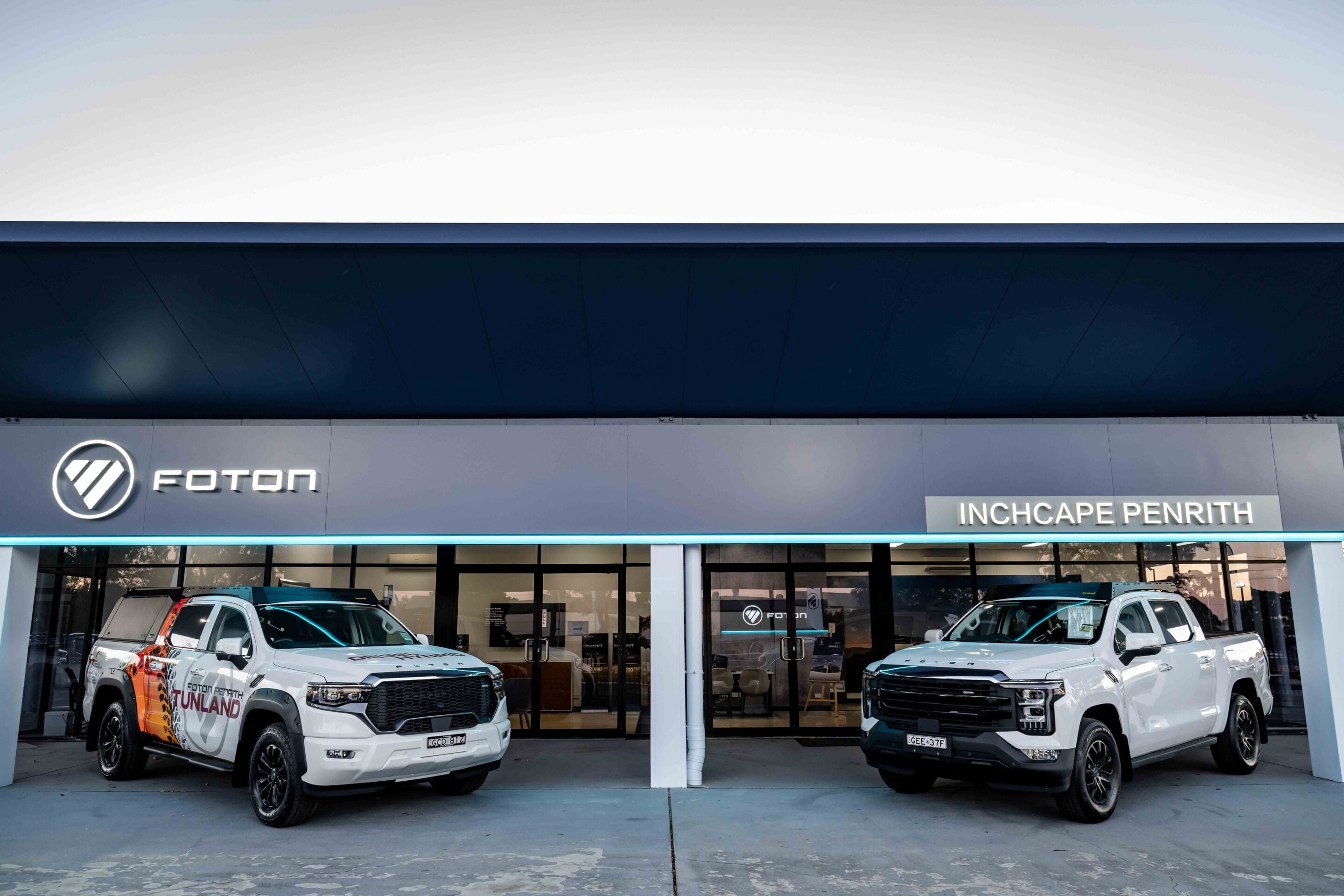
“The new Penrith flagship is an important milestone for Foton in Australia and gives us a clear showcase for how we want the brand to be experienced by our customers,” said Glen Cooper, General Manager, Foton Australia.
“We are investing across every aspect of the business – from new product and brand development to our dealer network, customer experience and aftersales capability. As we continue to expand and strengthen Foton’s dealer network across the country, the Penrith flagship will serve as the benchmark for future retail representation, helping shape a consistent, high-quality customer experience nationwide.
“Combined with Foton’s global manufacturing capability, product innovation and growing international presence, the new centre marks another significant step towards building a strong, trusted and enduring Foton brand in Australia.”
What this means for Australia
For Australian 4×4 buyers, the significance is less about the new showroom itself and more about Foton building a bigger local footprint around its ute and truck range. A broader dealer network and dedicated commercial vehicle sites should give the brand more places to sell and support its vehicles as it expands.
Toyota’s 40-strong HiLux fleet will run on renewable diesel at this year’s AFL Grand Final, with the fuel made from waste and vegetable oils.
The HiLuxes will transport the two Grand Final teams through Melbourne on September 25 for the Grand Final parade, with the entire fleet running on 100-per-cent Renewable Diesel HVO100. The same vehicles will also be used on Grand Final day for the lap of honour involving recently retired players.
“We’re looking forward to seeing thousands of fans line the streets to cheer on the teams and this year, for the first time ever, our 40-strong Toyota HiLux fleet will be powered by low-carbon liquid fuel,” said John Pappas, Toyota Australia Vice President Sales, Marketing and Franchise Operations.
“We see Renewable Diesel playing a role in Australia’s transition to lower-emission motoring, without leaving customers behind in the journey towards decarbonisation.”
HVO100 is a paraffinic fuel made from hydrotreated vegetable oil, using renewable feedstocks including waste oils and vegetable oil. Toyota Australia will trial and test the fuel in its vehicles as part of its work on low-carbon liquid fuels (LCLFs), which the company says have the potential to reduce lifecycle emissions from existing and future diesel vehicles.
The fuel is compatible with all HiLuxes produced from 2015 onwards and fitted with either the 2.8-litre 1GD or 2.4-litre 2GD diesel engines. Toyota says approximately 500,000 such vehicles are currently on Australian roads, giving the existing HiLux fleet potential to reduce lifecycle carbon emissions if HVO100 becomes widely available and adopted.
Toyota also plans to make other diesel vehicles compatible with HVO100 and says it is continuing to work with industry on opportunities for renewable diesel in Australia. The HVO100 program forms part of Toyota’s multi-pathway approach to decarbonisation.
Last week, Toyota announced its hydrogen-powered HiLux will enter production in 2028, adding a fuel-cell powertrain to the existing diesel and battery-electric options. The ninth-generation HiLux FCEV is set to use a third-generation hydrogen fuel-cell system producing 300kW, with more than 400km of targeted WLTP range and up to 2500kg towing capacity.
Toyota has indicated the hydrogen HiLux is expected to follow in Australia around the time of its European introduction, although local specifications are yet to be confirmed.
What is HVO100, and how is it made?
HVO100 stands for Hydrotreated Vegetable Oil 100, referring to a renewable diesel fuel made entirely from HVO. Despite the name, HVO can be produced from a range of renewable feedstocks, including used cooking oil, animal fats, vegetable oils and other waste and residue oils.
Unlike conventional diesel, which is refined from crude oil, HVO is produced by first cleaning and processing these feedstocks before treating them with hydrogen. The process removes oxygen and other impurities from the oils and fats, converting them into hydrocarbon molecules that are chemically similar to those found in conventional diesel.
The 100 in HVO100 means the finished fuel is 100-per-cent HVO, rather than a blend of HVO and conventional fossil diesel. HVO100 is therefore a hydrocarbon diesel fuel, rather than the chemically different biodiesel produced through the conventional transesterification process.
Toyota says using renewable and waste-derived feedstocks can reduce the lifecycle emissions associated with diesel vehicles. The actual reduction depends on factors including the feedstock and production pathway, including how the hydrogen used in production is produced.
GMC has introduced the locally specified Yukon Denali Signature Black in Australia, priced at $181,490 (RRP).
The full-size SUV is finished in Onyx Black paint with Black Vader Chrome detailing across the exterior. It also gets black badging, gloss-black trim and 24-inch Black accessory wheels, while the Australian specification adds an illuminated GMC grille emblem. The treatment extends across the grille, grille surround, front fascia, side mouldings and lower rear fascia, with gloss-black hood moulding and roof luggage rails also fitted.
Under the bonnet, the Signature Black retains the Yukon Denali’s 6.2-litre EcoTec3 V8 with Dynamic Fuel Management, producing 313kW and 624Nm. It is paired with a 10-speed automatic transmission and Active Response 4WD system, while Air Ride Adaptive four-corner suspension and Magnetic Ride Control are also fitted.
The Yukon Denali Signature Black retains a two-speed transfer case and electronic limited-slip differential, along with Trailer Sway Control and an integrated trailer brake controller. Maximum braked towing capacity is 3628kg when fitted with the appropriate weight-distribution hitch.
A 360-degree HD camera system provides up to 11 camera views, including Hitch Guidance with Hitch View. Safety equipment includes automatic emergency braking, adaptive cruise control, lane-keeping assistance and front and rear park assist.
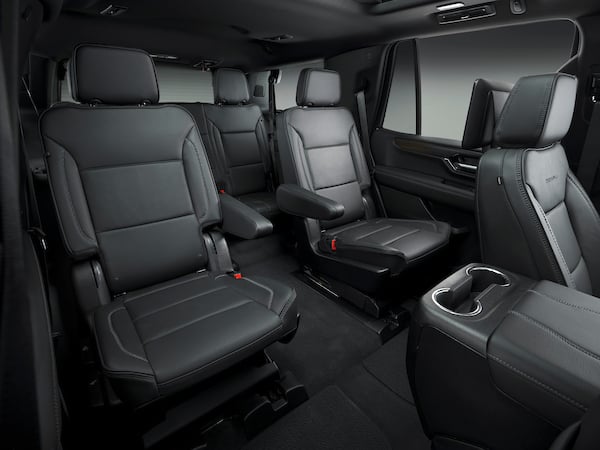
Inside, the Yukon uses a seven-seat configuration with second-row captain’s chairs. The seats are finished in Jet Black perforated leather-appointed trim, with heated front and rear seats and ventilated front seats. A 16.8-inch GMC Premium Infotainment System touchscreen, wireless Apple CarPlay and Android Auto, a Bose 14-speaker sound system and a 15-inch head-up display are also fitted.
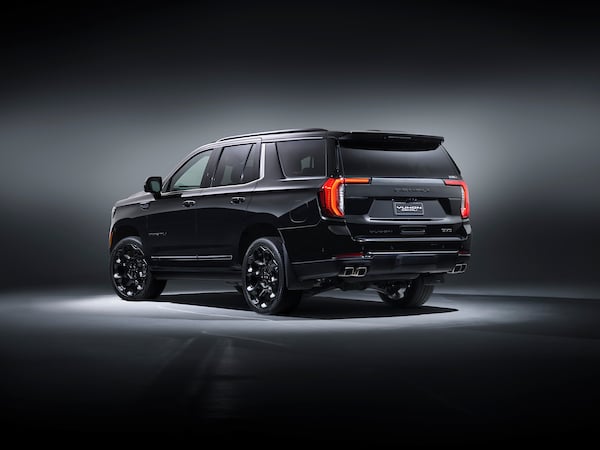
“The Yukon Denali Signature Black reflects how closely we listen to our customers and respond to what they want from a premium SUV. Developed with their feedback in mind, the second-row captain’s chairs and purpose-selected 24-inch wheels, finished in a distinctive all-black treatment, give customers a more individual expression of GMC luxury,” said Greg Rowe, Acting Managing Director, GM Australia & New Zealand.
“Together, these features elevate the commanding comfort and presence that already define Yukon, while maintaining the towing and touring capability our customers value.”
Key features: GMC Yukon Denali Signature Black
- 6.2-litre EcoTec3 V8 with Dynamic Fuel Management
- 313kW and 624Nm
- 10-speed automatic transmission
- Onyx Black paint
- Black Vader Chrome exterior detailing, including grille, grille surround, fascia trim, side mouldings and lower rear fascia trim
- Illuminated GMC emblem, Australian specification only
- 24-inch Black accessory wheels
- Black exterior badging
- Gloss-black hood moulding and roof luggage rails
- Seven seats with second-row Captain’s Chairs
- Power-sliding centre console
Remember a time when people bought 4x4s with diesel engines for their simplicity and reliability?
Some might say they were the good old days, as the engines were dependable, easy to service and could be repaired by the local mechanic in any town. But 4x4s with such engines were slow, noisy and considered dirty in terms of emissions, making them unacceptable in the modern era.
Common-rail diesel injection, piezo injectors, turbocharging and other systems have all worked to improve both the performance and cleanliness of diesel engines to the point where they are close to petrol engines in performance and remain more efficient. But the emissions systems and complexity of these modern engines have also made them less reliable and more expensive to maintain and repair.
For this reason, many drivers stuck with petrol engines where they could, thanks to the relative simplicity of a naturally aspirated, spark-ignition engine. Sure, the petrol engine used more fuel, but servicing was cheap and simple and it could deliver hundreds of thousands of trouble-free kilometres with just basic home maintenance.
But as petrol engines have decreased in size and been forced to run cleaner, they too have been encumbered with turbocharging, high-pressure injection, emissions systems and other components to maintain performance and clean up tailpipe emissions.
Add in hybrid drive systems and the powerplant under the bonnet of your 4×4 has become a very complex machine, and one that the local outback mechanic may not be able to help you with if something goes wrong, resulting in a costly trip on the back of a truck to the nearest dealer.
These are the things that were going through my mind while driving the LandCruiser GR Sport Performance Hybrid recently. Yes, it remains a LandCruiser in every way, in that it is a competent off-roader, a superb touring wagon and has a big, plush cabin, but there’s a lot of stuff going on underneath and under the bonnet as you drive along.
The V6 diesel engine in the same LandCruiser might not have the complexity of the hybrid system around it, but that modern diesel is still a very complicated powerplant. The truth is, you can’t avoid the complexity of modern powertrains in any new vehicle, but it is something that you should consider when thinking about your next off-road touring rig.
All of a sudden, purchasing an older 4×4 like an 80 or 100 Series Cruiser or a GU Patrol, then throwing $50K at it to make it as comfortable and reliable as possible, makes a lot of sense.
Defender has revealed a new military-spec ute as part of its Wolf Series II range, a next-generation light mobility vehicle developed for the UK Ministry of Defence.
The Utility Vehicle (UV) is one of three Wolf Series II variants, alongside a Tactical Mobility Vehicle (TMV) and Mono-Tactical Mobility Vehicle (M-TMV). In the UK, Defender operates as a standalone JLR brand, while in Australia it sits under the Land Rover umbrella.
All three use Defender’s D7x architecture, a heavy-duty monocoque platform developed to handle the loads associated with serious off-road use. The vehicles have been developed by JLR’s new Defender Defence Division for the Ministry of Defence Light Mobility Vehicle tender and will also be offered to NATO defence organisations.
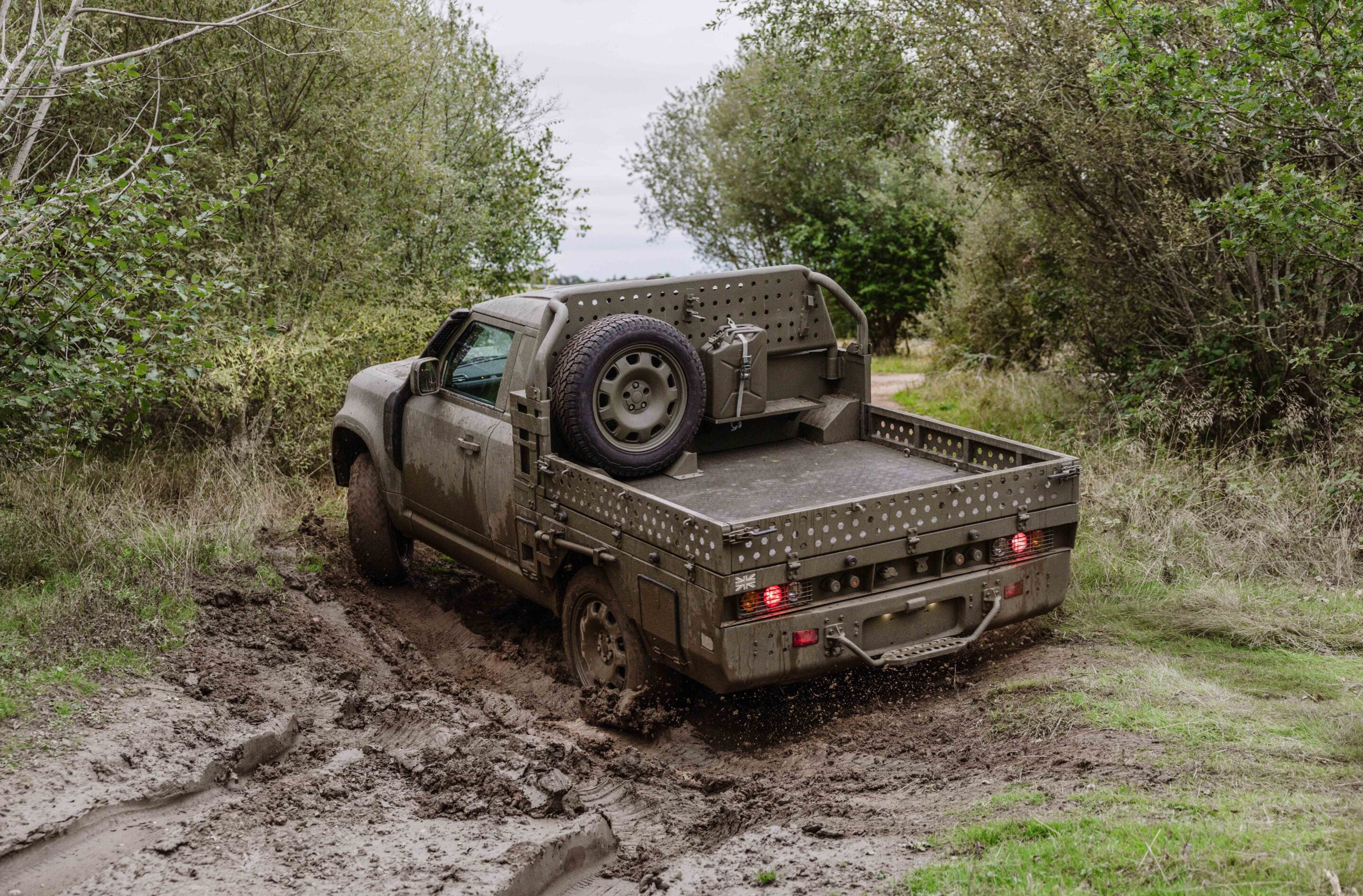
“I am delighted to reveal three new variants of Defender Wolf Series II, our next-generation military vehicle. Through our newly established Defender Defence Division, we will offer Defender Wolf Series II to defence organisations worldwide, while also bidding for the UK Ministry of Defence Light Mobility Vehicle tender,” said Patrick McGillycuddy, Defender Managing Director.
The Wolf Series II is Defender’s first military vehicle launch since the original Land Rover and Defender Wolf vehicles, which served with the British Armed Forces for more than 70 years.
“Defender Wolf Series II is exceptionally robust and versatile. Its D7x monocoque construction enables us to adapt the platform to the wide range of roles and operational requirements demanded by military organisations. It is a modern successor to the world-famous Defender Wolf and Land Rovers that have served the British Armed Forces for more than 70 years. Designed and engineered in Britain, with an engine built in Wolverhampton, Defender Wolf Series II also delivers sovereign capability,” McGillycuddy said.
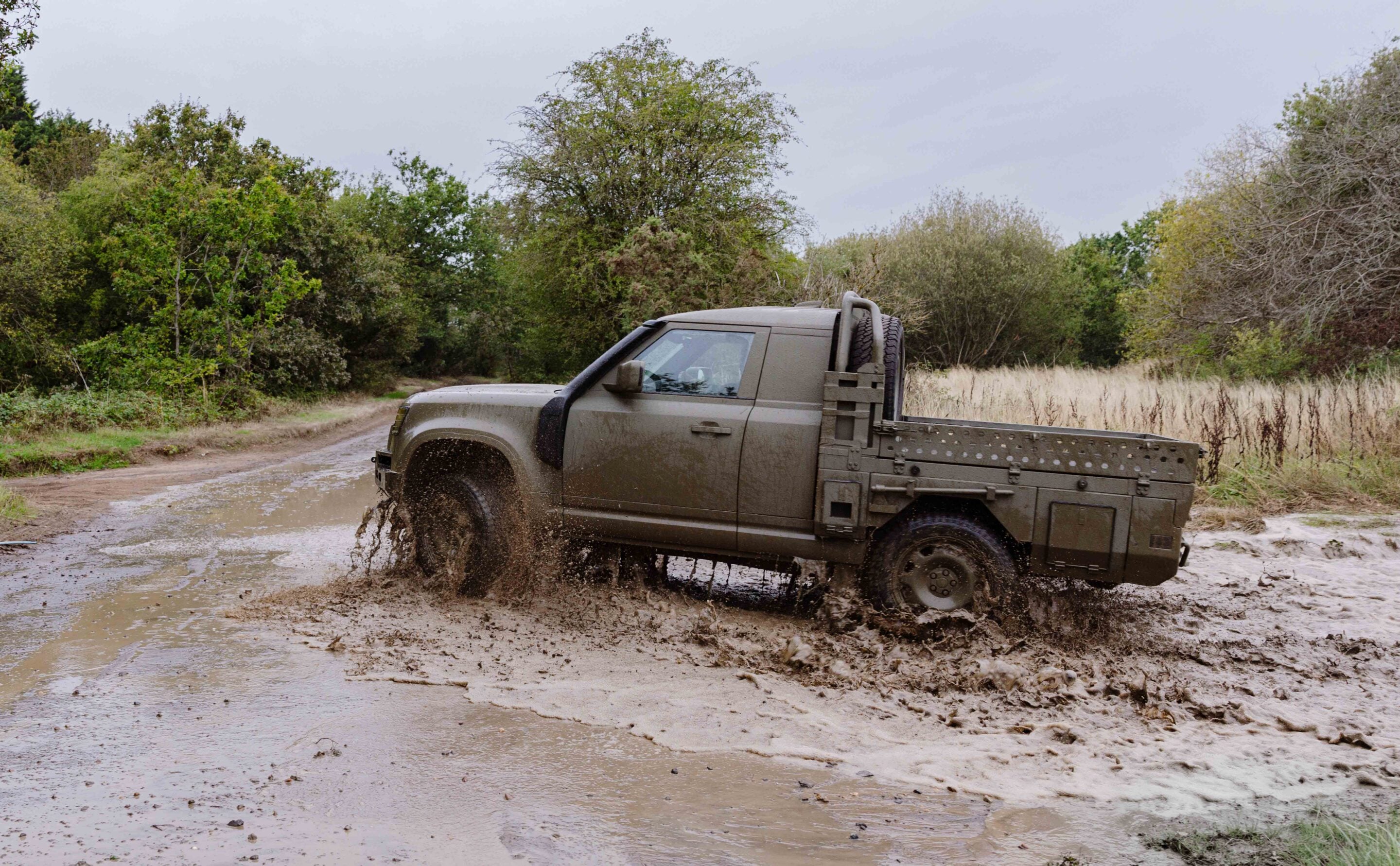
Defender says more than 62,000 tests were carried out during development, while the chassis and body architecture were engineered to withstand JLR’s Extreme Event Test procedure.
The Wolf Series II has also undergone off-road testing at an independent Ministry of Defence facility. Defender says it was the only vehicle to successfully navigate all of the obstacles during the demonstration.
The three variants were displayed at the Millbrook proving ground in Bedfordshire, UK, on 16 September.
What it means for Australia
Not much, at least for now. The Wolf Series II has been developed for the UK Ministry of Defence, with no Australian availability announced.
For local 4×4 enthusiasts, the main point of interest is the use of the D7x architecture and the fact that Defender is developing a military vehicle around its existing platform. But there’s no direct impact on the Australian Defender range at this stage.
The Wolf Series II also joins Defender’s existing Expert portfolio, which is used by emergency organisations including border forces, police, military and fire services.
It’s no secret that the 1GD-FTV 2.8L turbo-dizzle engine in our second-hand HiLux is a well-proven performer.
However, they’re almost as well known for having a less-than-optimal seal on the factory air cleaner housing, and there are numerous examples of dust creeping past the air filter and causing all sorts of dramas. That’s not just on the mighty HiLux either. Prados, 70 Series, Fortuners, if your vehicle has one of these engines and drives in dusty conditions, chances are the airbox will develop a leak at some point.
Luckily, our air cleaner still looked brand new, and the engine-side of the box could have had a meal eaten off it. But still, we take this thing wheeling regularly and we didn’t want to tempt fate when we’re halfway through the High Country. Something had to be done.
Airbox and air filter upgrade
Gotta love a HiLux, eh? These things have more aftermarket support than a Kardashian’s face.
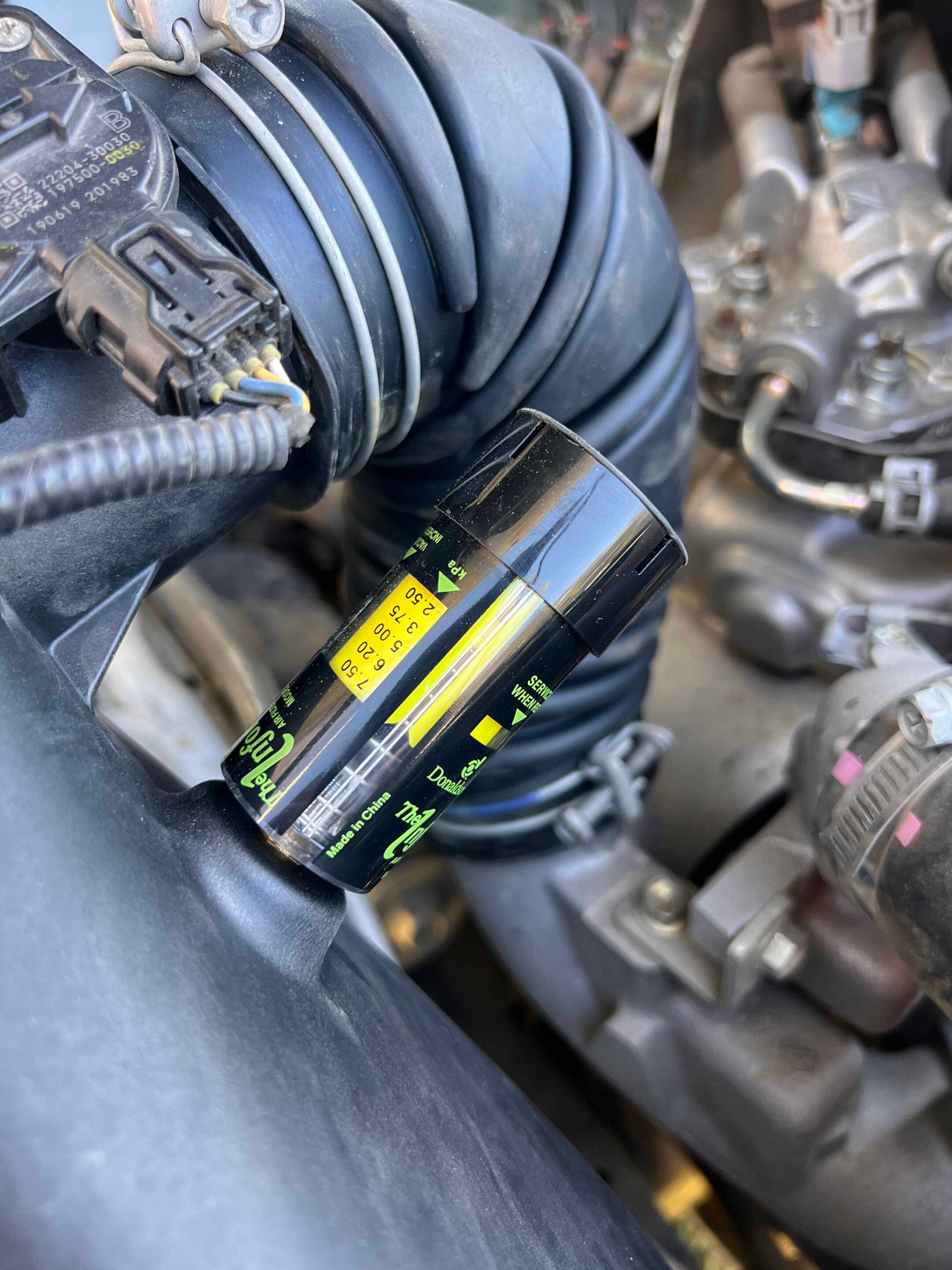
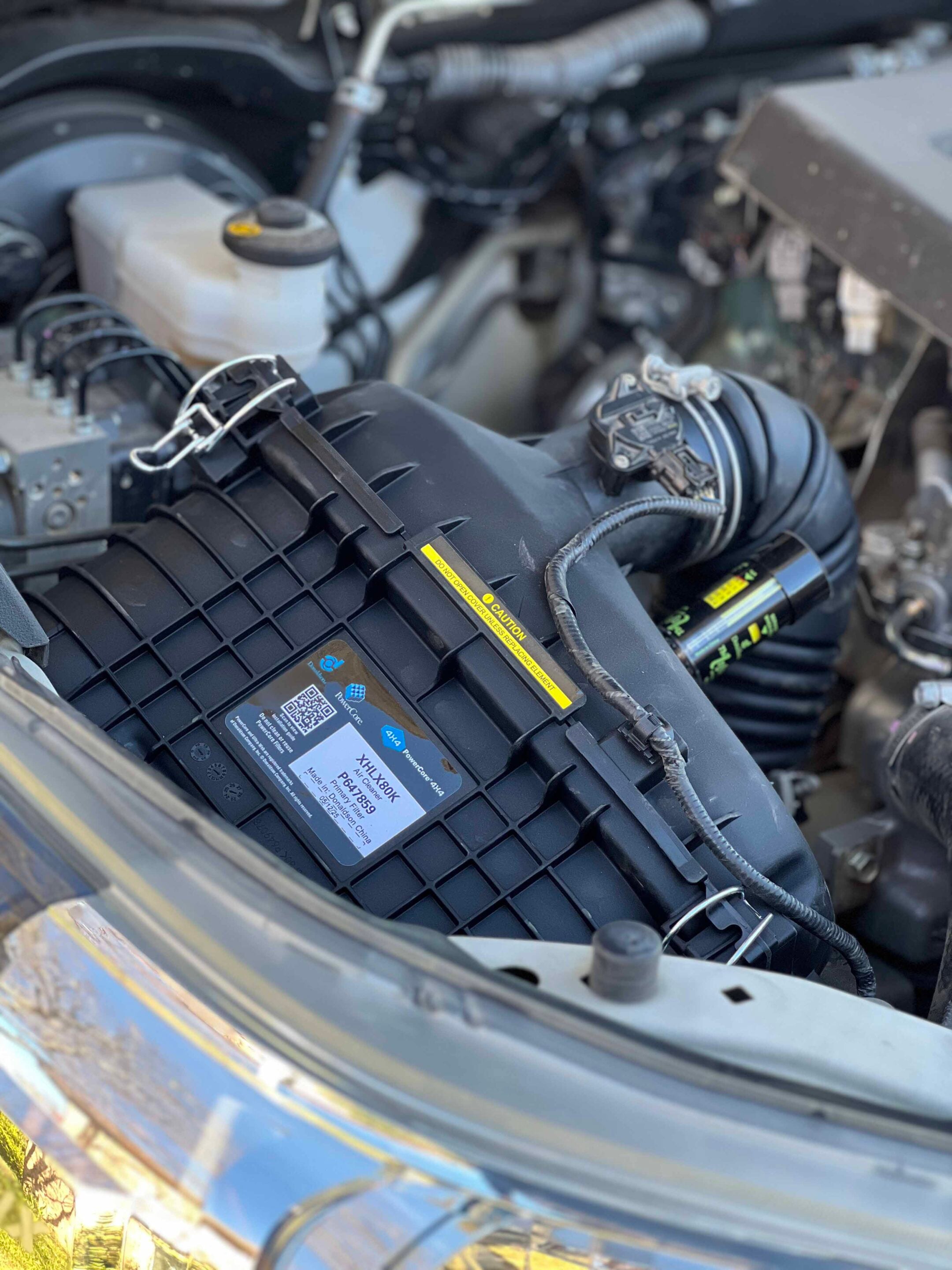
After some quick duck-duck-going we latched onto Australian filter legends, Donaldson (↗). These guys have been making filters since the first Toyota 4x4s landed in this country and have an airbox and filter combo specifically for the N80 and N90 Luxies. Score. We’ve also fitted one to our 2026 HiLux, so we’ll be putting it through its paces in the months ahead.
This is not just a replacement either. It’s a full-on upgrade. The filters catch more contaminants than the OEM paper filters while maintaining the same or better airflow. They also don’t need oiling or any maintenance other than undoing the three clips on the new airbox and throwing a fresh one in. To make life even easier, there’s a handy filter gauge that tells you when it’s time to throw in a fresh one.
Airbox installation
Look, this took a seriously underqualified journo about 20 minutes to remove the old airbox and have the new Donaldson installed. It’s not difficult.
All that’s required is a Leatherman, 10mm and 13mm sockets. The hardest part is removing the old MAF sensor screws that really wanted to chew out. Maybe because the incorrect screwdriver was used, but whatever. It mates straight up to the factory mounting points and air inlet, and there are adapters available for snorkels too. As far as preventative maintenance goes, fitting up one of these bad boys is a no-brainer.
Key benefits
- Better contaminant filtration
- Same or better airflow
- No oiling required
- Simple filter replacement
- Filter gauge shows when it needs replacing
Pricing
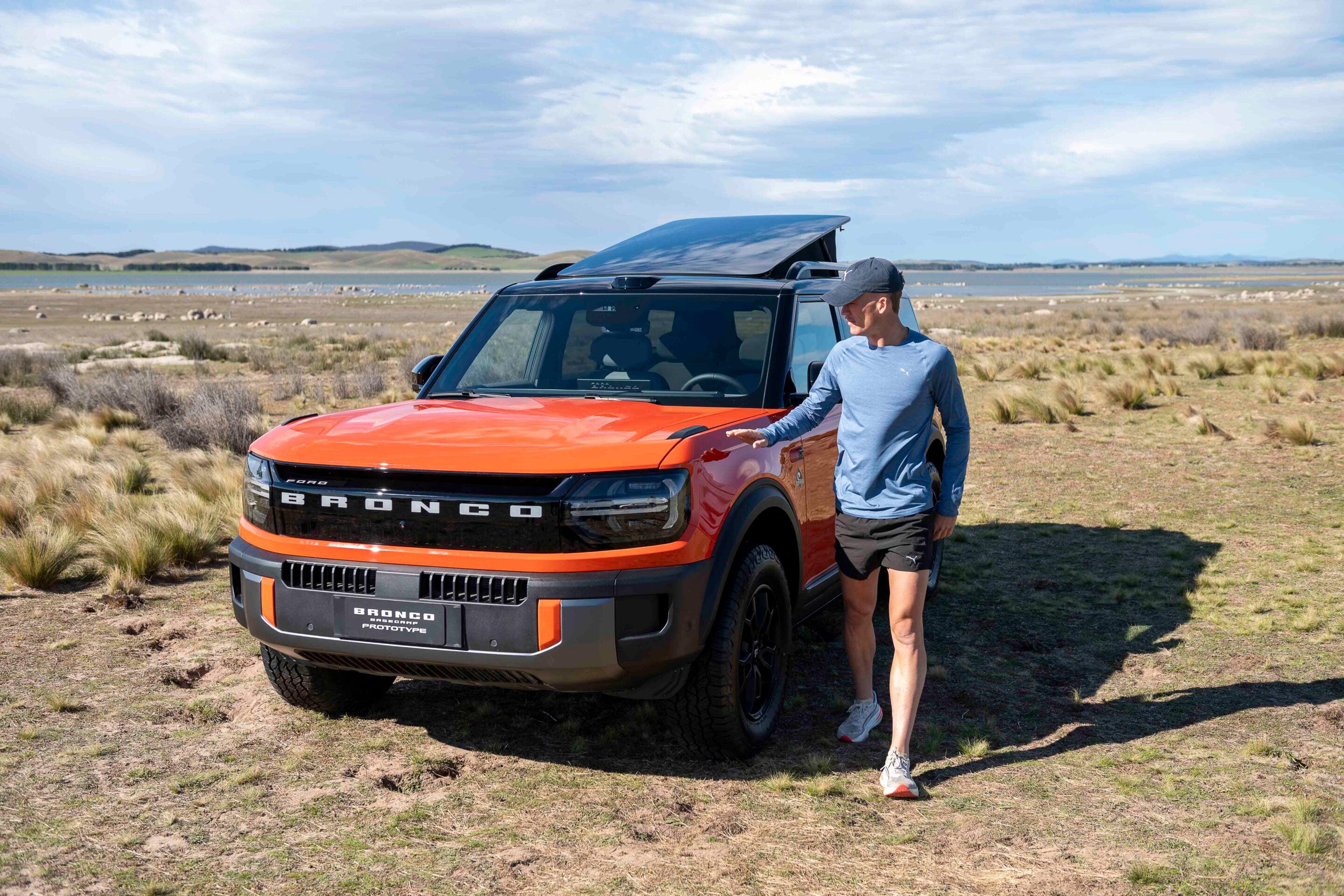
Ford has officially confirmed the electrified Bronco Basecamp will arrive in Australia and New Zealand in the second half of 2027, following the initial confirmation of the Bronco nameplate for Australia earlier this month.
The Chinese-made Basecamp is a light-duty plug-in hybrid SUV, with electric motors driving the front and rear axles rather than a conventional mechanical four-wheel-drive system. Its 49kWh usable battery is paired with a 1.5-litre turbocharged petrol engine that can charge the battery when required, while the battery can also be charged using home or commercial chargers. Ford estimates a combined touring range of 800 to 900km.
The Basecamp also gets several features aimed at camping and extended trips, including vehicle-to-load power for appliances and power tools, an induction cooktop integrated into a tailgate-mounted mini kitchen, and a food heater/chiller box. The rear seats fold flat to create a double bed, while a pop-up roof provides ventilation and allows occupants to sit upright inside.
“When we looked at how Aussies and Kiwis spend their time outdoors, the national parks, the coastal trails, and the distances they travel, the fit was immediate,” said Ambrose Henderson, Marketing Director at Ford Australia. “Outdoor life here isn’t a trend, it’s just life. Bronco Basecamp was purpose-built for these customers.”
The Basecamp is not the same vehicle as the Bronco Sport sold in the US and other markets. Instead, it is part of a Ford-JMC joint venture in China, with styling that draws from both the Bronco Sport and sixth-generation Bronco. The round headlights and traditional Bronco grille are among the styling cues carried across.
Ford Bronco Basecamp: what we know
- Australian arrival: Second half of 2027
- Built: China
- Powertrain: Dual electric motors + 1.5-litre turbocharged petrol engine
- Battery: 49kWh usable
- Charging: External charging + petrol engine
- Estimated range: 800-900km
- Drive system: Electric motors on front and rear axles
- Interior: Fold-flat seats forming a double bed
- Other features: Vehicle-to-load power, induction cooktop, food heater/chiller box, pop-up roof